
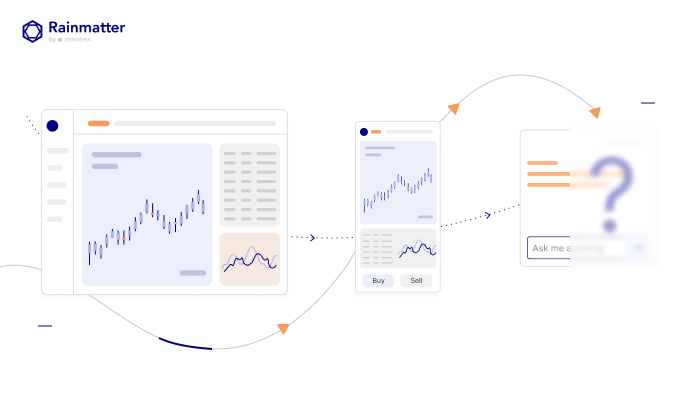
What will the future of trading and investing look like?
All investing and trading platforms kind of look the same now, don’t they?
I’m talking about Indian platforms, and sure, we can quibble about some features and some of the bells and whistles, but they seem to have converged into a broad sameness. Don’t get me wrong, I’m not saying they’re bad. I’m just saying they all look similar, which naturally leads to the question: what comes next? This is a question we keep asking ourselves at both Zerodha and Rainmatter. We have our own opinions, but for all we know, we might be missing something.
A quick step back.
We started Zerodha in 2010, and in the same year, if you had gone to any other broker, you would have gotten the same trading experience. Once you opened an account, you’d get an EXE file from your broker, typically either NEST or ODIN. Perhaps the most revolutionary feature of 2010 was the ability to change the colour of price changes from red and green to blue and red. That was pretty much it.
This was the case until we launched Kite in 2013, because until then brokers just offered off-the-shelf platforms built by vendors and didn’t build anything in-house. Once Kite launched, it became the benchmark for every other broker, and today, if you look at a lot of Indian trading and investing platforms, you’ll see that, for lack of a better way of putting it, they’re generously inspired by Kite.
Fast forward to 2026, and web platforms have pretty much killed desktop trading platforms. Thanks to the near-universal penetration of smartphones and cheap data, over 60-70% of all retail trading volumes now originate on phones. Along the way, the features available to retail investors have changed just as much, and people today have access to all sorts of things that would have been considered exotic back in 2013. Fancy screeners, tools for building portfolios, backtesting them, creating strategies, visualising them, executing them, and so on and so forth. All of it is table stakes now.
If you take the quality of the platforms in 2010 as your benchmark, today’s platforms look like they’re from the future. They’re better looking, faster, and feature-rich.
But if you abstract away the platforms and the features, the fundamental nature of trading and investing has remained the same. A user today does their own research, opens the platform, and executes the trade. Yes, thanks to brokers offering APIs, a small set of users have automated all of this, but it remains a small set. If you zoom out, the way traders and investors express their views hasn’t changed. It’s the same buy and sell window. The platforms on which they express those views have changed radically. The behaviour hasn’t.
You could argue SIPs changed this, and to an extent they did, since a recurring instruction removes the decision altogether. But a SIP, or a model portfolio, still resolves into that same buy and sell window, just scheduled or bundled.
All that said, and I want to be careful how I phrase this, there is a chance that AI fundamentally changes the way people trade and invest. To be clear, I’m not saying this as a booster or as a doomer. I say it as someone who has used these tools heavily and can see the direction of the journey. Whenever anyone writes about finance and AI, it’s easy to paint an exaggerated, rosy vision where we’re all soon going to be like Iron Man waving our hands at Jarvis, executing trades, and minting money. That’s stupid, and that’s not what I’m saying.
There have always been overhyped technologies that were supposed to revolutionise trading and investing, and I’m still waiting for these revolutions to happen. They were going to create waterfalls of alpha and turn poor retail investors into mini Warren Buffetts. As shocking as it may sound, this hasn’t happened. Whatever alpha was created went to the likes of Jane Street, which, if you go by the rumours, screwed over the average retail investor and became rich. Okay, I’m kidding.
The reason this time feels different is that LLMs are producing novel trading and investing behaviours. People haven’t just started asking them for advice; they’ve started building their own tools with Claude Code and Codex, things that solve specific pain points. A cursory look at the finance forums on Reddit shows the range, from something as banal as a custom tracker for their investments and expenses to genuinely wild things like using OpenClaw to automate trading off a variety of signals. Yes, a lot of this is problematic, and some of it is slop, but to focus on that is a kind of performative pedantry.
This is people using AI to build their own tools for the problems they personally face. Cooking at home instead of going to a restaurant where one menu is served to everyone. Personal software, instead of a mass-market product.
The other reason this time feels different is the popularity of the Model Context Protocol, or MCP, which lets people interact with their brokers through tools like Claude and ChatGPT in a completely different way. Plenty of people don’t like MCPs, and the protocol itself might not survive, but I don’t think the behaviour goes away. A lot of brokers, including us and Robinhood, already offer them. What surprises me is that, in some specific use cases, they’ve become the default mode of interaction, which is to say the trading platform might just get abstracted away, and the LLM might become the primary interface for a lot of users, if not all.
Users can now have a two-way conversation about their trades and investments as if they were talking to another person who has full context on them and designs strategies tailored to their circumstances. It’s kind of crazy. Today they can build their own “agents”, thin replicas of themselves, if you will, that act on their behalf, provided they’ve briefed them well and put in guardrails. None of this requires knowing how to code. All it takes is the ability to describe what you want in plain language, or pretty much any other language, for that matter.
Even if this were 2024, I wouldn’t be writing this, because what I’m describing wasn’t possible.
Debating whether these new behaviours end well or not seems pointless to me at this point. Yes, there are genuine questions to be asked about the risks and the scope for consumer harm, and they’re complicated, with a regulatory angle to them. But the genie is out of the bottle.
Considering the direction things are going, it doesn’t seem impossible that brokers end up as the providers of pipes, a prediction Nithin made a year ago. We would offer the ability to interact with the exchange; everyone would build their own interfaces on top, and all we would do in the background is collect the orders and send them to the exchanges. If you’re a broker, that’s scary and exciting at the same time. There’s a real possibility that brokers and other financial intermediaries, as they stand today, get radically disrupted.
What makes the threat of this disruption real is the inherent conflict of interest with existing platforms. Today, most user engagement is bottlenecked through these proprietary interfaces; without them, existing brokers would have no meaningful way to trigger customers to create engagement, which is just another way of saying trading activity.
At the same time, fundamentally disrupting how trading and investing work isn’t easy, because broking is heavily regulated. It takes financial muscle, talent, know-how, resources, and a lot of doing just to get a license and build a platform. It’s not impossible, but it’s not easy either.
But we’ve already solved execution. With Kite APIs, you’re essentially getting a broker in a box. Sensibull, smallcase, Tijori, and a bunch of others are good examples. They don’t have to be brokers because we’re the broker, and in the background we’re taking care of the execution risk, the compliance risk, the reporting risk, the risks around the flow of money, and everything else that comes with it. All they have to worry about is building a good product. Today, it is possible for small teams to build something substantial with us providing the plumbing. This is thanks to AI, which has dramatically lowered the barriers to building products.
That’s still true today, and it’s why we’re doubling down on the very first thing we started at Rainmatter, which is fintech. We want to back founders who have ideas on products that will not only make the lives of traders and investors easier but also help them do better with their money.
And we’re not just committing capital. We’re committing the same infrastructure that sits behind Sensibull and smallcase, the tools and the know-how we’ve accumulated, and 16 years of context from running Zerodha, including all the expensive mistakes you don’t have to make to learn them.
To be clear, we don’t know exactly what we’re looking for, but we do know what we’re not. Not another fancy dashboard with blinking green lights that aggregates publicly available financial data. Not another stock tips platform. Not another knockoff that visualises options payoff diagrams. Not a recreation of something that already works.
If you have a thoughtful idea about how trading and investing can be fundamentally rethought, that’s what we want to see. Reach out to us by filling out the form given here.

All good, but i wander why no access of back office from any broker, this will help us to update our dashboards report every EOD and even help in tax filling but every body is focused and obsesses with shine tools.