

Everything you need to know about Closing Auction Session (CAS)
Important changes from August 3, 2026:
Following the introduction of the Closing Auction Session (CAS), market closing times will be as follows; there are no changes in market opening time.
- Stocks that are part of F&O list: Continuous trading will stop at 3:15 PM, followed by Closing Auction Session
- All other stocks: Trading will close at 3:30 PM
- Index and stock F&O contracts: Trading will close at 3:40 PM
If you are trading intraday using the MIS product type, note the auto square-off timings effective August 3, 2026:
- Equity (stocks under CAS): 3:12 pm
- Equity (stocks not under CAS): 3:25 pm
- Index and stock F&O contracts: 3:26 pm
You can check the latest intraday auto square-off timings here.
Every day, stock exchanges have to determine the “closing price” of a stock. This closing price is used for a bunch of important things:
- Computing the value of the Index (Sensex and Nifty). Nifty and Sensex are calculated as (Closing Stock Price x Number of Shares = Market Cap / Base Value).
- NAV of a Mutual Fund scheme is determined by AMCs based on the closing price of the stocks.
- For F&O contracts, the closing price of the underlying stock is used for final settlement on expiry day.
It’s needed for other things too:
- For brokers to show you P&L reports, they need a closing price. For something as simple as calculating your portfolio value.
- When you pledge stocks as collateral, they’re also valued at the closing price.
Now that we know we need the closing price of a stock, let’s understand how it’s calculated. Today, the closing price is not equal to the Last Traded Price (LTP) of the last trade at the stock exchange.
You can’t just take the LTP of a stock as the closing price. Imagine a stock that’s traded actively between Rs. 1,000 and Rs. 1,010 throughout the day. But at 3:29 pm, someone sells 10 shares at Rs. 980 in a thin moment. That Rs. 980 becomes the LTP, but it doesn’t truly reflect where the market values the stock. To counter this, exchanges currently use the VWAP method to calculate the closing price.
VWAP = Sum of (Price x Volume of each trade) / Total Volume
Starting August 3, 2026, SEBI wants to redefine the manner in which the closing price of a stock is calculated by introducing a Closing Auction Session.
You can watch this video in Hindi here.
Why the need to change the methodology?
In the current system, the VWAP price is discovered for all trades happening via the Continuous Trading Session (CTS). SEBI believes that if CAS were to replace this, it leads to better price discovery because all buyers and sellers submit their orders into one common pool during the auction window. So instead of scattered trades happening at different times as they would during a CTS, you have one big pool where everyone’s interest is visible at the same time. Because everyone’s orders are in one pool, the closing price that emerges reflects the collective view of all market participants.
This also helps in improving efficiency for the execution of large orders. Today, if a mutual fund wants to buy or sell large quantities of shares, they have to break the order into much smaller orders to avoid moving the price against themselves. In CAS, since all orders are pooled together, a large buyer is more likely to find a large seller at the same price point, making it easier and cheaper to execute big orders.
Also, it’s a global norm. Most large markets, such as the NYSE, LSE, etc., use CAS, and these are amongst the most trusted markets in the world. It also helps index fund managers and ETFs significantly reduce their tracking errors.
What changes for traders and investors?
As a retail trader trading in equity and derivative markets, here’s what you need to know. In Phase I, the equity segment is divided into two categories:
- Category I: Stocks on which F&O trading is allowed
- Category II: All other stocks
In Phase I, CAS will be applicable only for Category I stocks; these are stocks on which F&O contracts are traded on both NSE and BSE. This means:
- Stocks that don’t form part of CAS: regular trading will continue till 3:30 pm.
- Stocks that form part of CAS: trading stops at 3:15 pm.
- Derivatives market stays open till 3:40 pm.
For CAS stocks, here’s how things will work when trading stops at 3:15 pm:
| Session | What happens | Time |
|---|---|---|
| 1 | Reference price calculation, transition from CTS to CAS | 3:15 pm (5 mins) |
| 2 | Order entry: both limit and market orders | 3:20 pm (5 mins) |
| 3 | Order entry for limit orders only, market orders locked, random close | 3:25 pm (5 mins) |
| 4 | Order matching | 3:30 pm (5 mins) |
If you are trading intraday using the MIS product type, note the auto square-off timings effective August 3, 2026:
- Equity (stocks not under CAS): 3:25 pm
- Equity (stocks under CAS): 3:12 pm
- Equity and index derivatives: 3:26 pm
You can check the latest intraday auto square-off timings here.
Here’s a breakdown of the entire process:
3:00 pm to 3:15 pm
Between 3:00 pm and 3:15 pm, regular markets (continuous trading session) are functioning as usual. Alongside, the exchanges are also calculating the VWAP of these 15 minutes. This VWAP price becomes the “Reference” price, think of it as an indicative price that is carried forward into the closing auction session.
3:15 pm to 3:20 pm
At 3:15, the market for all Category I stocks stops. The market is transitioning from CTS to CAS. The exchange calculates the reference price during this time. The price band in the CAS session will be +/- 3% of the reference price calculated. No orders are allowed from 3:15 to 3:20 pm. If there are any open orders from CTS, they are carried forward into CAS except SL orders and orders placed outside the price band, which will be cancelled.
Futures orders placed outside the applicable price band will also be cancelled. This does not apply to option orders.
3:20 pm to 3:25 pm
Order Entry Session I is opened. One can place both market and limit orders during this time. The exchange starts sharing the following information on a continuous basis: (a) indicative equilibrium price (b) total buy/sell quantities (c) imbalance quantities (d) indicative index value
3:25 pm to 3:30 pm
Order Entry Session II is opened. Here, only limit orders can be placed. Market orders cannot be modified or cancelled. This session closes randomly between 3:28 pm and 3:30 pm, this is to avoid last-minute flooding of orders.
3:30 pm to 3:35 pm
The exchange stops accepting all orders and runs the equilibrium price algorithm, in which all orders match at the equilibrium price. This price now becomes the official closing price of the stock.
How is the equilibrium price determined?
This is the bit where it gets slightly confusing. Let us give it a shot. Let’s say the market depth for a stock during CAS looks like this:
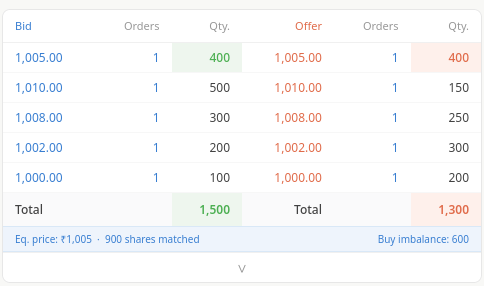
From this market depth, one can ascertain the following:
A buyer willing to pay Rs. 1,010 will also buy at Rs. 1,005 — they’ll take any price equal to or below their limit.
A seller willing to accept Rs. 1,000 will also sell at Rs. 1,005 — they’ll take any price equal to or above their limit.
So we build a cumulative picture:
| Price | Cumulative Buy Qty | Cumulative Sell Qty | Executable Volume |
|---|---|---|---|
| Rs. 1,000 | 1,500 | 200 | 200 |
| Rs. 1,002 | 1,400 | 500 | 500 |
| Rs. 1,005 | 1,200 | 900 | 900 |
| Rs. 1,008 | 800 | 1,150 | 800 |
| Rs. 1,010 | 500 | 1,300 | 500 |
Rs. 1,005 has the highest executable volume of 900 shares, so Rs. 1,005 becomes the equilibrium price/closing price. If two prices tie on executable volume, the exchange picks the one with the smaller imbalance between buy and sell quantities. If that’s still tied, it goes with the price closest to the reference price.
Once the equilibrium price is determined, orders are executed at this price in the following sequence:
- Market orders get priority over limit orders.
- Eligible market orders are first matched with one another based on the time they were placed.
- Any unmatched market orders are then matched with eligible limit orders using price-time priority.
- Finally, the remaining limit orders are matched with one another, again using price-time priority.
If you have any questions, let us know in the comments.

I sold 5,000 quantity of 24000 CE @ Rs. 50 at 3.39 pm today, which was the LTP price. but closing price come to 75 ( It was not expiry day )
Earlier, I was told that there is some difference due to VWAP. But now we have CAS (i.e. ). Then why such a huge difference? Is option contract closing price is not decided by CAS on non – expiry day. Because if the Index Spot price has been calculated at 3:28 PM. the option price should be run accordingly
Maybe it is because the option contract will have its own closing price as per the WAP of the last 30 minutes of trading. On expiry, the final settlement will be based on CAS.
Excellent
Due to CAS system,
#. SEBI proved that Institutions are important like Govt focus on A&A, they gave whole INDIA to A&A.
#. SEBI wants to eliminate retail sellers and give the whole control to Institutions.
#. Close your positions before 3:15 PM,
#. blindly buy the ATM of CE,PE and leave it for LUCK.
#. Either Lxxx (Luck) or Fxxx
Please give a different colour code for all the CAS shares (like brown, blue or any other colours for easy identification)
If at all the auction prices during CAS can be monitored, please suggest what is the source to monitor and where to track them
Now it is getting better with only 8 point variation between 3:15 closing and final CAS.
Zerodha should implement a IEP/CAS live tracker for all the stocks and indices that are part of the auction. Else, retail trader will be just sitting ducks. Such a rushed out move by SEBI. They should have just did few trail sessions on non-expiry days. Make the retailers well aware of the system, get their feedback and implemented on expiry days. I’m worried how it gonna splatter on monthly expiry.
Hi Vinothkumar, we’re working on adding this to Kite’s market depth. For now, during CAS, the stock’s reference and indicative closing price will be shown in the Nudge in the order window.
Zerodha’s explanation is detailed and very simple to understand, you have described it beautifully. Thanks.
But, for some reason, beyond my understanding, there is a lot of confusion in the final closing price of Nifty and Bank Nifty on day 1. Nifty showed a 200 points higher close on day 1 which leads to a lot of confusion in figuring the right call or put price (nifty index) in the morning of day 2. Again a higher closing at the end of day 2 has lead to the same confusion on day 3 morning.
I hope I am not the only one who is facing this issue.
I wonder if SEBI has thoroughly back-tested this whole thing, or is it a trial and error at our cost.
Bringing in newer and global standard products and processes is always welcome, but so much confusion for the retail investors is not accepted.
Now large institutions can analyze the data for the whole day and decide on a target price for the day and accordingly create positions in F&O before 3:15PM on an expiry day. Later during CAS, they can place enough buy / sell orders to bring Index / stock to their target price so that they can hugely profit on a expiry day. On the other side, retail traders are totally blind folded during CAS.
why 3:15pm candle is missing for f&o stocks. Other brokers and tradingview is showing this
Absolute Cinema
Good one
Fno yesterday trade expiry exit time….
I have read.please close the tab
hi this new system of CAS has created confusion. option call or put positions have taken a beating and presently showing huge losses more than the normal. will these losses reduce or pile up more.or will today’s CAS will make a difference
SEBI has given a massive opportunity to institutional players to close the market at their target price on expiry day, enabling them to make huge profits. Previously, they had to aggressively buy or sell throughout the entire final 30 minutes to achieve their target price. However, with the new Closing Auction Session (CAS), they only need to manipulate trades in the final minute of the session to successfully close the market at their desired price.
Brilliant. You figured it out completely. That was the whole point. Wipe out retailers. It’s. Hiroshima Nagasaki moment for retail
Sebi proved it it’s a manipulating in market
authority
That is what is now happening, Intentional or unintentional. Instead of a natural price movement now the individual investors are getting cooked with help of SEBI.
Why Nifty closed by 1.6% where as Sensex is 0.7%. Unable to understand this discrepancy.
Please help me in understanding.
SEBI has given a massive opportunity to institutional players to close the market at their target price on expiry day, enabling them to make huge profits. Previously, they had to aggressively buy or sell throughout the entire final 30 minutes to achieve their target price. However, with the new Closing Auction Session (CAS), they only need to manipulate trades in the final minute of the session to successfully close the market at their desired price.
#nifty closed 24774 and Aug futures at 24664, this itself shows there’s a glitch. SEBI Must issue a clarification on this.
under this government not a single work is done properly in 1 go.
these sebi lunatics must have backtested it first.
BEL traded between 388 and 388.5 between 3 PM and 3.15 PM. Market closed at 3.15 and then at 3.40, suddenly the closing price was shown as 392.15. Same was the case with SBI; it was more than 1% above what the closing price would have been as per the old system. Sadly, I did not know what was happening behind the scene in that last 25 minutes. Will it become more transparent?
I have two more questions with regard to the CAS.
1. WIth the defunct system , an expereinced trader/investor can see what might be the closing price of the stock from the chart. Will such an information be available to me under CAS? I feel the closing price could be shrouded in mystery uner the CAS.
2. Do I get to know the market depth under CAS so that I can see if my order has any possibility of being filled?
More embarrasingly, the ATM calls of both stocks remianed almost unmoved, giving no hint of this explosive rally.
SEBI has given a massive opportunity to institutional players to close the market at their target price on expiry day, enabling them to make huge profits. Previously, they had to aggressively buy or sell throughout the entire final 30 minutes to achieve their target price. However, with the new Closing Auction Session (CAS), they only need to manipulate trades in the final minute of the session to successfully close the market at their desired price.
Exactly
All retailers can close zerodha account and peacefully do our work, instead if fighting with institutions
But how come NIFTY jumped some 200 points at 3:30 pm whereas Nifty Aug Future just made 30 point move. Nifty aug future should’nt matchup with closing aution price?
Also is the closing aution only for NSE and not for BSE. NIFTY50 moved, but SENSEX stayed clam.?
CAS is for both NSE and BSE.
Dear Zerodha – please let me know who can I track live, the equilibrium price of Nifty and Bank Nifty during CAS.
Today’s CAS indicates that Indian market is not ready for this. Only lack of liquidity in Nifty and Bank Nifty stocks can explain the way these indices closed today. Anyone who had bought MF units today in Nifty and Bank Nifty index funds (and probably large cap funds) would get the allotment at artificially high price.
As expected, today’s CAS system caused sharp price dislocations. For example, DIVISLAB’s bid–ask around 3:15 pm was ~8338–8340, yet the closing price at 3:30 pm (after CAS order matching) printed at 8585 — far above the continuous trading level. Traders don’t see this shift until the close is posted, which means they can be blind‑squeezed.
Options didn’t swing wildly today since it wasn’t expiry, but imagine this on expiry day: sudden moves could push positions ITM, creating huge gamma exposure. Even though theta is gone on expiry, market makers can profit from gamma, while directional traders face unexpected risk.
This makes the options market vulnerable to manipulation under CAS. Unless positions are far OTM (say, underlying >3% away from strike at 3:15), it’s risky to hold them into expiry hoping they expire worthless.
well said, lets wait for SEBI Clarification
If all they wanted was better closing price discovery, that would not be affected by small trades, then they could have simply used a weighted-average price calculation mechanism rather than implementing a complicated and a non-transparent system.
well said, lets wait for SEBI Clarification on this
How is the daily candle data going to be ? for some till X and for others till Y ? If we are getting market data through API then this gets another level of difficulty. Why cant everything end at a specific time and then they run whatever auction they have and then arrive at a closing price ? See for today itself the index jumped so much in the auction and this is going to be difficult to handle.
Good
Waiting for the day when the Indian market will run in line with gift nifty timings. Huge disappointment for us to trade only half the day. Same with mcx. SEBI is keeping Indian traders at a disadvantage and poor
Please use natural tone – English/Hindi. This sounded more like a robotic tone despite having a human character in the video.
00kay
i improved my knowledge about trading
Yes nice
Live auction price list will be shown to us at same time ?
Will we have access to the live auction price list at the same time?
Hi Prachi, we’re working on adding this to Kite’s market depth. For now, during CAS, the stock’s reference and indicative closing price will be shown in the Nudge in the order window.
Will you give some hint at buy/sell window that the stock is in CAS.
Hello I have query on alerts/conditional order/ATO which are a feature provided by zerodha. I use these orders to execute exit orders(stoploss) in nifty synthetic futures. I execute orders in Fno based on nifty spot levels. But after 3:30 pm will these order be valid or i need to execute the exits manually. How to keep track of the nifty current price at that time?
Hi Anish, for indices and stocks listed in the F&O segment, ATO, GTT, and Alerts will not trigger once continuous trading closes at 3:15 PM.
It looks like more of premarket concept… now applicable to post mkt to determine the closing price.
I want you to edit in the video. the market dept which you have showed in the video and in the post are different. but the calculation is same. So it gets confusing in the video where the calculation dosent match as per the market dept showed in video.
Don’t complicate the simple system. Ppl like simple n understandable system.
It will impact in intraday trading?
If the market closes on 3:30 Pm for regular CAS stocks and Indices, on what information F&O will be traded till 3:40 PM if the spot doesn’t move ?
Hi Satya, 3:30 PM is not when the CAS-eligible stocks close. Their continuous trading stops at 3:15 PM; CAS runs until 3:35 PM. The F&O contracts continue trading until 3:40 PM.
Between 3:15 and 3:40, F&O prices can move even though the underlying stock is no longer in continuous trading. They can react to the indicative equilibrium/closing price emerging from CAS and demand/supply in the F&O contract itself.
Good
Very Good intiative
Just bignner
If I trade morning got profit before 12 pm example ITC trade sell in 800 buy in 780 is it executed or wait until 315 auction reply me
What impact nifty 50 index option.
I wanted to clarify how market depth will be displayed on Kite during the CAS period (3:15 pm – 3:30 pm).
During normal trading hours, market depth reflects bids and asks of limit orders, since order matching happens on that basis.
However, during the CAS period, order matching is based on maximum executable quantity.
For traders to accurately track the expected closing price, the market depth should ideally reflect prices ranked by executable quantity in descending order. In that case, the price shown at the top would most likely correspond to the closing price, unless a new order at another price point creates a higher executable quantity.
Could you confirm whether Kite’s market depth display will adapt to reflect this CAS-based mechanism, so traders can effectively monitor the closing price during that window?
Hi Ashish, not currently. We’re working on adding this to Kite’s market depth. For now, during CAS, the stock’s reference price will be shown in the Nudge in the order window.
What will be cutoff time for mutual fund purchases
Hi Sudeep, no changes in mutual fund cut-off timings.
From 3.35 pm to 3.40 pm it will be a CTS or only the orders placed in CAS session will be executed by that time?
Hi Sridhar, the CAS matching is completed by around 3:35 PM. After that, the underlying stock does not resume continuous trading. However, F&O contracts continue normal continuous trading until 3:40 PM.
Great
Suppose I place sell order at 1025 in CAS and equilibrium price is 1020 – will the order not executed
There is lot of ambiguity in the write up..Absolutely no clarity.
What is the error message will display if I place orders during transition period 3:15 to 3:30?
Please explain matching logic?
What will happen unmatched orders after cas end?
3:15 to 3:20
where to see this things (a) indicative equilibrium price (b) total buy/sell quantities (c) imbalance quantities (d) indicative index value
Hi Jay, we’re working on adding this to Kite’s market depth. For now, during CAS, the stock’s reference and indicative closing price will be shown in the Nudge in the order window.
Is this somehow going to impact Gap Openings going forward? In my opinion it will be a good thing if it does (if it reduces gaps).
Hello
Please let us know through the dedicated page , which will tell, what is changed for index option trading (intraday and positional).
Will index option trading be halted for sometime ?
If not , will what time , we can trade the index options . What is the new index option auto square off time ? Is it 3.25PM or 3.40PM
Hi Yuvraj, F&O trading will not be halted. Only change is trading will continue until 3:40 PM instead of 3:30 PM. Intraday auto square-off in F&O segment will happen at 3:25 PM if you are trading using MIS.
Hi, this may be a naive question but I’m confused
Mainly regarding how will the closing price of the underlying stock as well as the future be determined?
Will the underlying stock stop trading at 3:15?
Will both have CAS or is CAS just for the underlying? F&O trades normally – just timing of the same is extended to 3:40?
Will all trades on the underlying after 3:15 to 3:35 all be settled at the same price which is the closing?
What about the trades after 3:35?
Can you please throw some light on these points. That would be a great help.
Hi Ayushi, for stocks covered under CAS, normal trading will stop at 3:15 PM.
CAS applies only to the underlying stock in the cash market. Futures and options will continue trading normally until 3:40 PM; there is no auction in the F&O segment.
During CAS, orders are collected first and then matched at a single equilibrium price. All executed CAS trades will take place at this price, which becomes the stock’s closing price.
After CAS matching ends around 3:35 PM, there will be no regular trading in the stock.
The futures contract will have its own closing price under the existing mechanism, which is weighted-average price of last 30 minutes of trading. On expiry, however, its final settlement will be based on the underlying stock’s closing price determined through CAS.
The article is confusing & doesn’t give answer clearly for what is the change. Zerodha shall delete this article and upload a clearer version (easy to understand for all)
Hi Anwar, please let me know which bits you found confusing? Will help. Since there are some moving parts, it can be a bit overwhelming to get at first.
Hi instead of taking 1000 to 1010 let’s take huge gap and explain how it works… what are all the orders in between and how this will execute
what about BEES, ETF?
Hi Vansi, ETFs are not part of CAS and will tarde until 3:30 PM.
Only fo underlying stocks are applicable for cas
Market order High priority below logic
Market – market
Market – limit
Limit – Market
Limit -limit
Send this
This will highly impact to the FnO traders. As they may think a price is ITM or OTM at 3:15 but everything can be changed as the closing price can be +/-3% of the indicative price.
A large institutional firm can place the buy/sell orders in such a way that will benefit them the most if the price moves up +/-3% of the indicative price, and it can be a nightmare for a retail trader.
This gives a lot of room for a particular script to get operated very well on an expiry day.
If you are at the money (+/- 3%) then consider squaring off positions before 3:15 on expiry day. Only leave unsquared positions for OTM stocks that are beyond the 3% threshold or for stock where you are ok then moving to ITM during CAS period.
I won’t necessarily say it will create havoc. but yes now traders will have to evaluate even the OTM stock and not leave them open after 3:15. Also squaring off will mean some extra cost for traders (Brokerage + option price) that they will have to bear.
Will have to wait and see how market makers behave during this period i.e. does the option price reflect the intrinsic value or are they trying to squeeze the trader during expiry day square off.
But if they do that, trading activity will drop eventually and the revenue they are hoping to make will drop as well.
actually F&O trading will continue till 3:40 so you can still square off positions till 3:40 I believe, after the closing price of the underlying has been determined at 3:30. But the risk of a large move still remains from 3:15 to 3:30, during which time traders will not be able to immediately react to adverse price moves as they are happening. They will only see the total move at 3:30. Perhaps someone can clarify.
True a very complicated for retail investors.
As a retail investor what I get from this article is that for me the closing time is 3.15.
This government does everything what benefits the big fish
FOR NIFTY AND SENSEX INDEX OPTIONS NRML will you allow fresh order placement order modification / cancellation till 3;40 pm ?
Yes, Nick. You will be able to trade in F&O segment until 3:40 PM.
Follwing are my questions if anyone could give a clear explanation to it
1. ”During the 3:15–3:30 pm CAS window, when constituent stocks are not in continuous trading, how will the live Nifty/BankNifty index value be computed and disseminated — is it based on the indicative equilibrium price feed from the auction, and at what frequency is it updated?”
2. ”Will index options and futures continue normal continuous trading until 3:40 pm exactly as today, with no auction mechanism applied to the derivatives segment itself?”
3. ”For index options market-making/pricing purposes, what index reference value should be used for computing theoretical premiums between 3:15 pm and 3:30 pm, given the underlying’s continuous trading has paused?”
4. ”Does the shift of the F&O settlement VWAP window to 3:10 pm–3:40 pm change how daily MTM settlement price is computed for index F&O, or does it apply only to expiry-day final settlement?”
5.”Will historical/live data feeds (via APIs like KiteConnect) tag or timestamp the indicative index values separately from the final post-auction index value, so algos can distinguish them programmatically?”
Sr. Mujhe English jda nahi ATI aap ishka Hindi me bhi mail kar de to aap ki maherbani hogi
Hi Ansar, you can watch this Hindi video for all the details: https://www.youtube.com/watch?v=X8Ri23wtc9Q
Use translate on chrome browser
is this the move towards continuous trading session for extended hrs ? and break session is being introduced now in first phase?
For f&O contract continuous trading bye Agu normally
What is the impact on nifty and Banknifty Options on the expiry day,will the OTM strike price become zero at 3:15 or 3:40pm?
Hi Himanshu, at 3:15 PM, continuous trading ends for stocks covered under CAS, but Nifty and Bank Nifty options continue trading until 3:40 PM. During CAS, the exchange will publish an indicative closing value for the indices, which may change as the indicative equilibrium prices of their constituent stocks change.
Once the final closing values of Nifty and Bank Nifty are determined by around 3:35 PM, it will be clear which options are ITM or OTM.
How will on stock expiry day it will decide itm or otm?
Hi Pradip, the moneyness of an option is determined using the underlying asset’s final closing price on the expiry day. Until now, this closing price has been calculated using the volume-weighted average price of the last 30 minutes of trading.
From August 3, the final closing price will be determined through the Closing Auction Session (CAS), and this price will be used to determine whether an option expires in-the-money or out-of-the-money.
Expiry day index options will expire at what time?
3:40 PM, Pradip.
Sir, does that mean we should complete all our trading before 3:15 PM to be on the safer side?
Yes. square off within appropriate margin. for example if you have written a PE at 100 and the stock is 102 at 3:15, then your position is not safe. better to square off unless you are ok with delivery.
actually F&O trading will continue till 3:40 so you can still square off positions till 3:40 I believe, after the closing price of the underlying has been determined at 3:30. But the risk of a large move still remains from 3:15 to 3:30, during which time traders will not be able to immediately react to adverse price moves as they are happening. They will only see the total move at 3:30. Perhaps someone can clarify.
Note: I am not from zerodha. Just sharing my understanding.
Yes pls
The article says once equilibrium / closing price is determined, market orders and then limit orders and then so on will be executed.. 3 Questions
1. What price will the market orders be executed at? The equilibrium pricce just determined, or something else? Because the bid-ask price at the time that market order was placed is no longer available.
2. Unmatched market orders will be matched against limit orders???? How does an umatched market order exist? Exchange has already cancelled outside-band guys, so by definition, market orders must execute at whatever bid-ask was happening at the time of placement, it cannot remain ”unmatched”
3. Limit orders are matched with each other … what does that mean — a limit order has a price, and either market is moving toward that price or staying away from it. Here, closing price has already been determined, so instantly either limit orders will know if they execute or if they won’t
Hi Sammy, CAS works differently from continuous trading. Orders entered during CAS are not executed immediately against the prevailing bid or ask. They are pooled until the order-entry period closes, after which the exchange determines a single equilibrium price. All orders executed in CAS, market as well as eligible limit orders, are executed at this equilibrium price.
A market order can remain unmatched when there is insufficient quantity on the opposite side. For example, if there are market buy orders for 1,000 shares but market sell orders for only 400 shares, the remaining 600-share market buy quantity is first matched against eligible sell limit orders. Any quantity that still remains unexecuted is cancelled at the end of CAS.
For limit orders, the equilibrium price determines eligibility. A buy limit order is eligible if its limit is at or above the equilibrium price, while a sell limit order is eligible if its limit is at or below it. Since there may be more eligible orders than executable quantity, the exchange uses price-time priority to decide which orders are filled. All such trades take place at the equilibrium price.
Why these people keep making changes Now its so confusing. Why fix something which aint broken? Already no leverage, now this.
Shubham
CAS may ”work differently”, but definitions don’t change. Can’t change!!! The definition of a market order is ”any price will do” – the market maker CANNOT refuse a market order placed when the exchange was open unless and until trading has been halted in that scrip. Otherwise, if EXECUTION NOT PRICE is not guaranteed, why call it a market order to begin with. So, an unmatched market order does not make sense at all.
You also said – All orders executed in CAS, market as well as eligible limit orders, are executed at this equilibrium price — which means this ”closing” price is applicable to all market orders, buy or sell, period. Limit orders that do not satisfy the price will get cancelled, sure because Limit guarantees price not execution, but how can a valid market order get rejected?
I think the confusion is around what a market order guarantees.
A market order means that the trader has not specified a price limit and is willing to trade at the available execution price. It does not guarantee that the entire order will be executed. Execution still depends on sufficient quantity being available on the opposite side.
This is true even in continuous trading. A large market order can be partially filled if the available sell or buy quantity is insufficient. The remaining quantity may stay pending or be cancelled.
In CAS, the difference is that orders are not matched immediately when they are placed. They are pooled until the auction closes, after which the exchange determines one equilibrium price. Market orders receive priority and are first matched against opposite-side market orders, followed by eligible limit orders.
If the total market-buy quantity is greater than the total eligible sell quantity, the excess buy quantity cannot be executed because there is no counterparty. In that case, any unmatched quantity is then cancelled after CAS.
If I have already punched in my orders in the morning normally post 3.30 ..price freezes and then again ..i punch my next days orders by late evening but what happens at 3.15 pm now .. will i have to punch in the same orders again to participate for the 3.15 to 3.30 slot or my orders will be active.. please clarify
Hi Nadeem, if there are any open orders from continous trading session, they are carried forward into CAS except SL orders, Iceberg orders, and orders placed outside the price band, which will be cancelled. We’ve explained this above in the post.
Will cas start showing under Auctions tab in kite app after this change?
Hi Amit, no. You can place orders in CAS like you normally do.
Great
Noted. But you could have clarified in one single sentence that all stocks without F&0 banner do not come under CAS. Or simply put CAS operates for derivative market and the underlying. I had to refer AI for a simple explanation.
Why is this change? what does this slove?
IT WILL IMPACT IN COMMODITY SEGMENTS?
Hi Muthu, CAS is not applicable for Commodity segment.
Will 3pm moves become more subdued or more vigorous because of this new scheme?
If I want to sell a stock and buy another stock with the proceeds / Margin of the first stock I sell, how will this happen ? Will Zerodha provide the margin or forced to sell before the CAS starts
Hi Sushant, no changes in this. You can continue to use sale proceeds to buy other stocks.
So I can put both sell and buy orders during the CAS period ? And Zerodha will do the sell first and buy later ?
Hi Sushant, order execution in CAS is different from that during normal tarding session. Please check out the final section of the post to know how it works.
I read it again. But no answer there. I think you should read my question again too Shubham. Zerodha gives 100% credit for shares sold on the same trading day. But it’s not clear how it will give this credit for sell orders placed during CAS. e.g If I have to sell 100 reliance and buy N number of Infosys shares. How will I know if my reliance shares will be sold fully and not cancelled? And how do I decide how many shares of Infosys can I buy from the sale proceeds of reliance if part of them can get cancelled ? Or do I need to keep cash margin for the Infosys buys ?
Should I sell reliance before CAS and then I know how much cash proceeds get credited and then I buy Infosys based on latest price. ?
Ah, got it. CAS works differently from continuous trading. Orders are pooled and then matched in a specific sequence:
– Market orders get priority over limit orders.
– Eligible market orders are first matched with each other based on the time they were placed.
– Any unmatched market orders are then matched with eligible limit orders using price-time priority.
– Finally, the remaining limit orders are matched with one another, again using price-time priority.
This means it can be difficult to predict exactly when your sell order will be executed during the CAS.
If you want to sell shares and use the proceeds to buy other stocks, it’s better to place the sell order before 3:15 PM and then place the buy order during the CAS.
Can you give an example from Retails Investor/Trader perspective. Like what will happen if I want to sell say Reliance 500 shares at EOD and square off my 1 Short Reliance Futures Position pls.
What impact will it have on Nifty index option?
Hi Vijaya,
For stocks in the F&O segment: You can buy/sell normally like you currently do until 3:15 PM. If you want to buy/sell after that, you will need to place your order during the Closing Auction Session (CAS), which will then match and execute at 3:30 PM. (We’ve explained exactly how CAS works in the post above).
For all other stocks: CAS does not apply. You can continue to buy/sell shares normally until 3:30 PM.
For F&O contracts: Continuous trading will happen until 3:40 PM instead of 3:30 PM, and you can place orders normally like you currently do.
Hope there will not any difference between the Price Which i sold shares and Futures price. Is that the objective?
basically if i do arbitrage will the price match(between shares and Futures) at Expiry day EOD pls.
On expiry, settlement happens as per underlying close price, so there will be no gap.
SEBI has given a massive opportunity to institutional players to close the market at their target price on expiry day, enabling them to make huge profits. Previously, they had to aggressively buy or sell throughout the entire final 30 minutes to achieve their target price. However, with the new Closing Auction Session (CAS), they only need to manipulate trades in the final minute of the session to successfully close the market at their desired price.