
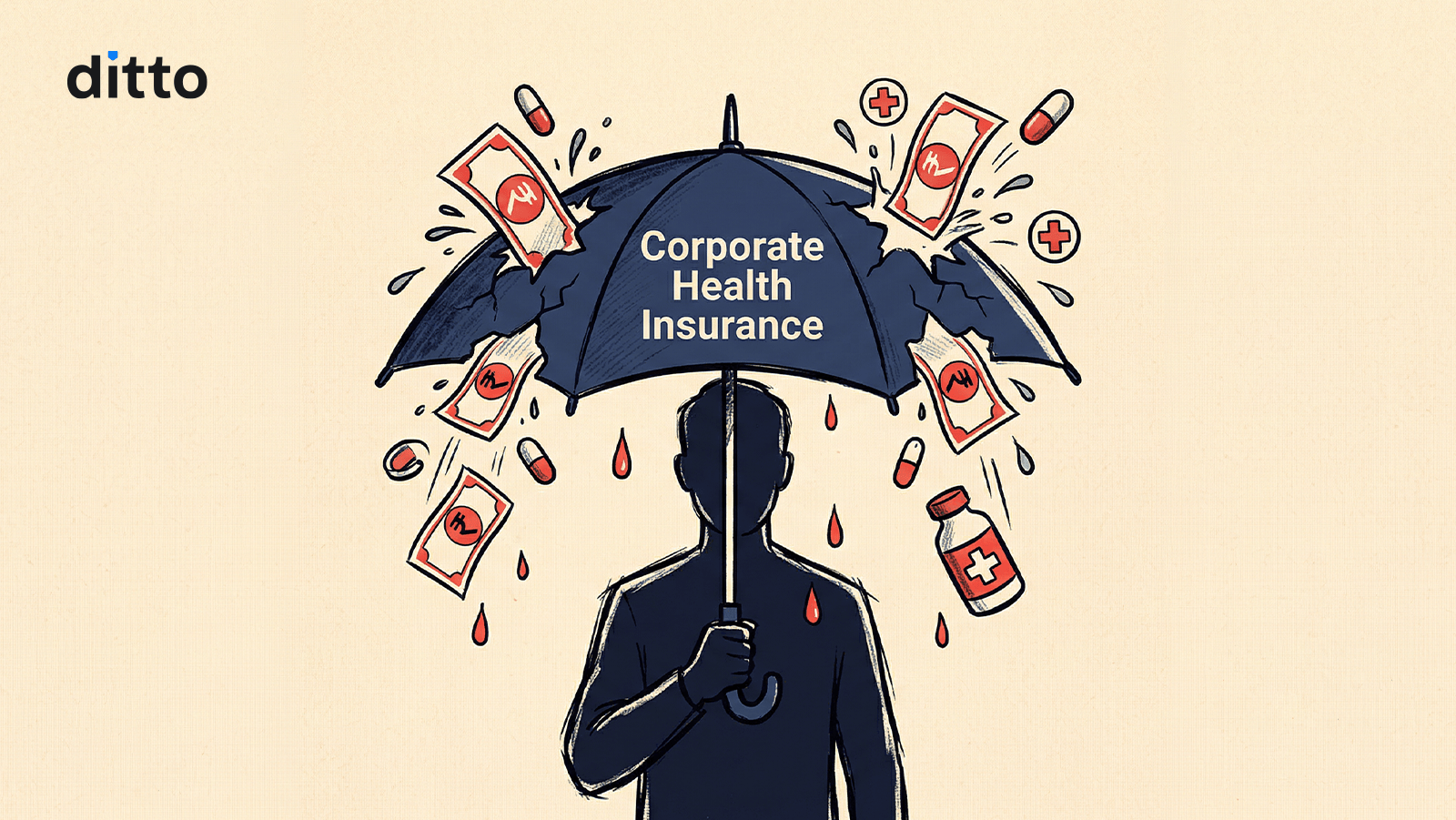
Does your employer’s health insurance actually protect you?
Here’s something we see more often than we’d like at Ditto. Someone calls us after a layoff or a resignation, and somewhere in the conversation they mention they need to “sort out insurance now.” When we ask about their current coverage, they say their company had a ₹5 lakh group health insurance plan, which the HR confirmed during onboarding. When we ask about a personal policy, there’s a pause.
“I didn’t think I needed one.”
It’s an honest answer. But it’s also one that quietly leads people into one of the most costly insurance mistakes we see. Because by the time someone calls us in this situation, they’ve usually already lost their coverage. The group policy ended the day they left the company and they’ve spent years assuming they were covered in a meaningful, lasting sense.
So in this article, we’ll explain why it’s worth considering a retail health insurance policy alongside your corporate cover.
The important caveat: You don’t own your employer’s policy
See, when your company buys a group health insurance plan, it’s not you but the company that is the master policyholder. You are a beneficiary on that contract for as long as you remain employed there. The day you resign, get laid off, retire, or even move to a subsidiary that isn’t covered under the same plan, that coverage ends. There’s no grace period or extension by default. You’re off the list, effective from the last working day.
Let us tell you why this matters more than people acknowledge.
Let’s say you rely entirely on employer cover from age 25 to 35. During those ten years, you develop Type 2 diabetes. It’s controlled but it’s on your medical record. At 35, you decide to start your own business or take a break. Now you need a retail policy for the first time.
The next thing you know is that every insurer is asking you about pre-existing conditions. Diabetes shows up. And depending on the insurer and the severity, you’re looking at a loading on your premium, a few years in exclusion for diabetes-related conditions, or in some cases a flat rejection. So the nine or ten years you spent under group cover offer you almost no credit here. You’re essentially underwritten as a 35-year-old with a pre-existing condition buying insurance for the first time.
Now compare this to someone who bought a retail policy at 25 in good health. By 35, their waiting periods are long past, they’ve saved themselves from loading charges, and ten years of clean renewal history is working in their favor.
What about portability?
IRDAI rules do allow you to port from a group policy to a retail policy and carry over your waiting period credits. In theory, this means that if your employer’s plan covered you for three years, that time can count towards your waiting period on a retail plan.
In practice, however, there are several hiccups.
First, most employees don’t even know this option exists until they’ve already left the company. Second, health insurance portability requests have to be initiated during a specific window, typically 45 to 60 days before the group policy’s renewal date. So if you’ve left mid-year, there’s no renewal window that coincides with your exit. Third, the process requires documentation from your former employer, cooperation from the group insurer and a new insurer willing to take you on. And even when waiting periods do port over, you may still face fresh underwriting based on your health profile at that time, and the coverage you land on may not be equivalent to what you left behind.
The coverage itself is often different
Beyond continuity, the actual coverage under group plans tends to be more restricted than people assume.
Many employer plans are negotiated on a cost-first basis. Companies want to offer a benefit without blowing the budget, so the plan they land on often has room rent sub-limits, co-payment clauses, or lower coverage for specific procedures.
Room rent sub-limits are extremely common. A ₹5 lakh plan that caps room rent at ₹3,000 per day sounds like a minor inconvenience. But if you take a room above the cap, the insurer doesn’t just deduct the difference in room rent but also proportionally reduces the entire claim. Surgeon fees, anesthetist charges, procedure costs, all of it gets cut down. This one clause can quietly slash a settlement by a huge percentage.
Then we have co-payment clauses, which mean you pay a fixed percentage of every claim out of pocket. Some group plans have these quietly embedded in the fine print.
Disease-wise sub-limits impose a separate, lower cap on specific conditions such as cataracts, joint replacements, hernias, etc., regardless of your total sum insured. So a ₹10 lakh plan with a ₹1 lakh sub-limit on cataract procedures pays up to ₹1 lakh for that surgery and not a rupee more.
Restoration benefits, which refill your sum insured if you exhaust it mid-year, are rare in group plans. So are modern treatment coverages done robustly and home hospitalization.
And more importantly, you can’t choose your preferred insurer, add riders, or customize anything. The plan your company picked is the plan you get. If it doesn’t suit your family’s specific medical history, there’s very little you can do about it.
On the other hand, a comprehensive retail policy, chosen carefully, has fewer or no restrictions at all. And because you picked it yourself, you know exactly what you’re covered for before you need to use it. With group cover, you usually find out what you don’t have when you file a claim (which is also the worst possible time to find out).
A note on what this costs you over time
The reason we emphasize these is because there’s a financial dimension to this that people underestimate.
You see, health insurance premiums are eligible for tax deduction under the old tax regime. A retail policy in your own name gets you this deduction every year. With a group policy provided by your employer, the portion of the premium paid by the employer does not qualify for any tax benefit, even though it forms part of your overall CTC. Only the portion of the overall premium that you contribute yourself can be claimed as a deduction.
Then we have medical inflation, which in India runs at around 14% annually. So a ₹5-10 lakh cover that feels adequate when you’re 26 will feel very inadequate by the time you’re 36 and actually need to use it. Retail policies can be upgraded, the sum insured can be increased at renewal (subject to underwriting) and you have control over other tweaks. With group cover, you get whatever cover your employer renews each year, which is usually the same number, because companies don’t like increasing their insurance spend significantly.
So what should you actually do?
The answer isn’t to ignore your corporate cover. Use it. When smaller claims go through the group policy, your retail policy stays clean and your no-claim bonus keeps building. So think of it as a useful backup plan.
But alongside it:
- Buy a retail policy while you’re healthy. Mid to late twenties is the right time. Underwriting is easier, premiums are lower, and waiting periods start running immediately. Every year you delay is a year of waiting period that hasn’t started, and potentially a new health condition that hasn’t appeared yet.
- Read your group policy document, not just the summary. Look for room rent limits, co-payment clauses, sub-limits, and what the restoration and bonus benefits look like.
- Don’t wait for a job change to trigger this thinking. By that point, you’re already uncovered and potentially uninsurable on easy terms. The time to sort this out is when everything is fine, precisely because everything is fine.
- If you do leave a job, explore portability quickly. Talk to an advisor within the first few weeks. Don’t let the window close without understanding your options.
- Take the sum insured seriously. Most employer plans offer ₹5-10 lakhs. That’s not a lot in a Tier 1 city if something serious happens. A retail plan with ₹15–25 lakhs, supplemented by a super top-up, gives you real protection at a surprisingly affordable premium.
So yeah, the employer policy is generous, and you should be grateful for it. But the policy that protects you when it matters is the one you own yourself.
If you want to know how much personal coverage you really need, or whether your current setup is enough, you can always book a free consultation with experts at Ditto. We will help you figure it out, step by step, with no spam and no pressure.

good read