
Introducing Venttup
Deepening the Engineering Stack for Indian Hardware
While speaking to our climate and deeptech portfolio companies we learnt about a very specific problem: Designing a product is no longer the hard part. The pain point is in translating design into production. It is tough to find a reliable domestic partner who can take the engineering drawings and deliver a small number of certified and high tolerance components at a reasonable price and within a reasonable time.
A parallel story is true in massive engineering conglomerates like Reliance, L&T, Siemens and Hitachi etc. A large chunk of mechanical, electrical and electronic components for our strategic manufacturing sectors like renewable energy, grid infrastructure, aerospace and electric mobility are still imported.
Even if you visit any shop floor in India today, the CNC machines or laser cutters that make most of the “made in India parts” are still imported from Germany or the US.
India can’t just assemble imported kits on imported machines. We need to own our manufacturing, it’s the only way to deepen our engineering and deep tech capabilities.
For this. We have invested in Venttup, a Bengaluru-based engineering and manufacturing company that is building the operational bridge between component development, indigenisation and scalable domestic production.
Why Marketplaces Alone Don’t Solve Hardware
One common assumption as to why we import so many precision components is that we lack workshop capacity. That’s not entirely true.
Thousands of Micro, Small, and Medium Enterprises (MSMEs) run CNC machines, foundries, forging presses and sheet-metal shops across India’s industrial clusters.
Indigenisation and domestic content requirement is creating unprecedented demand for sure but it’s still hard to fulfil this demand.
The missing link is the engineering translation layer between the buyer and MSMEs.
Imagine a power-grid company, aiming to increase the domestic content or localise an imported part, or imagine a space-tech startup that needs some precision-machined or aerospace-grade components. They can’t simply WhatsApp a CAD file to a local machine shop who can then manufacture it.
There is a layer in between this.
This layer includes reverse engineering, metallurgy validation, design-for-manufacturability (DFM, re-engineering a part so it can be produced reliably at scale), vendor qualification, and multi-stage quality documentation; all in equal measures to ship out a viable product. This is the missing link.
We tried solving B2B manufacturing through horizontal marketplaces and pass-through trading platforms in the past. It has its merits and serves its purpose. It worked for high-volume commodity procurement, but breaks down when applied to deep tech and complex localisation. This won’t work going forward as we deepen our manufacturing stack.
Whenever an engineering team develops or tests a new part they just need a single digit number of units initially, and that too quickly. Doing this through a standard pass-through trading model, doesn’t make sense on timelines and margins for a small custom order for 3rd party workshops. Someone needs to build a rapid prototyping service for this.
Even when you move to larger orders without owning the engineering problem, the gross margins are in low single digits.
We think B2B manufacturing localisation cannot scale with razor thin brokerage margins. It scales when someone owns the engineering stack from the drawing board to the final quality sign-off, and that’s what Venttup aims to do.
In-House Precision Meets Distributed MSME Scale
Founded in 2023 by Sandeep Nair (CEO), M. Wasim Ankli (COO), and Joseph Panakkal (CMO), people who saw this problem up close in their previous dealings with procurement, tendering, and localisation programs at heavy-engineering giants like Hitachi, Siemens, and L&T. They know exactly what engineering teams and hardware founders actually need.
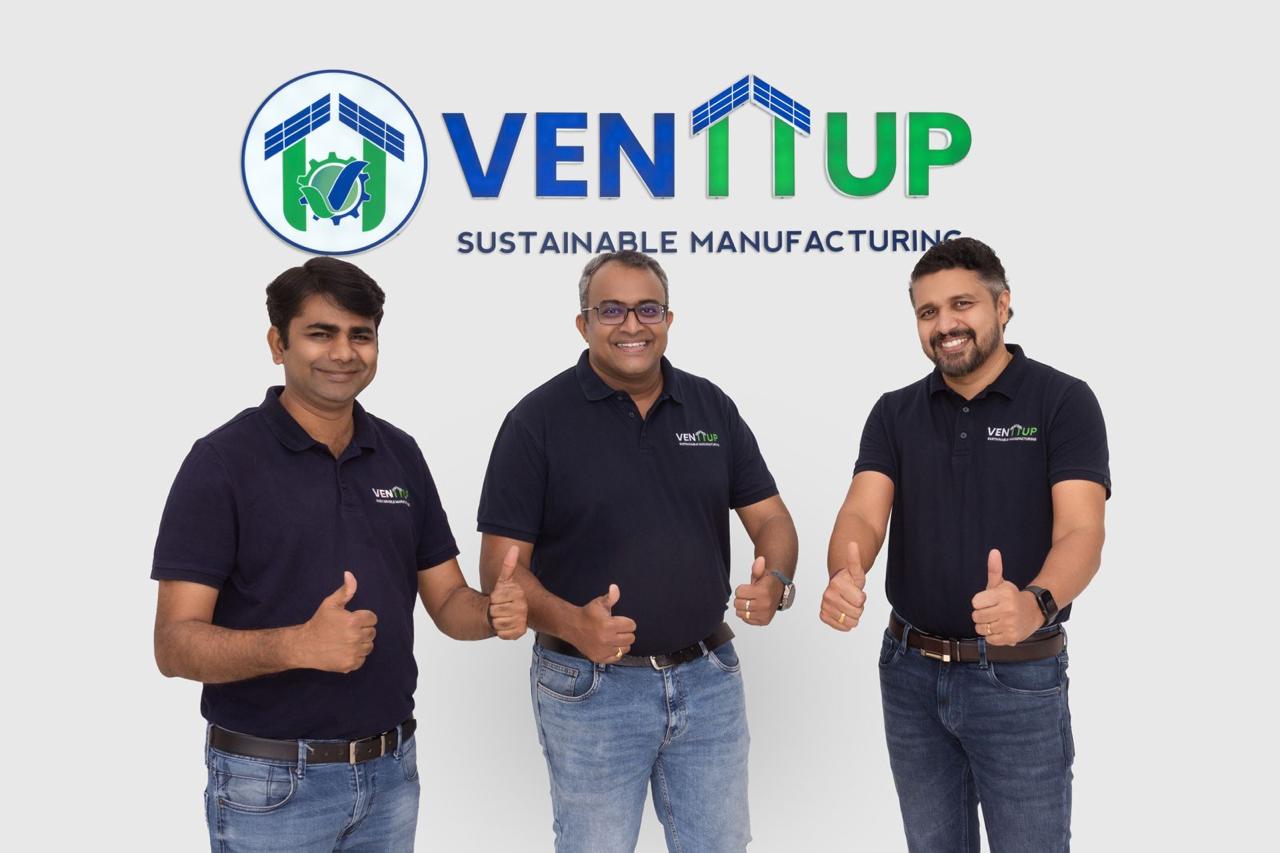
Their idea of Venttup is an engineering-first Manufacturing-as-a-Service (MaaS) company that operates across 3 complementary layers :
1. End-to-End Indigenisation via the GATE Process
Rather than treating manufacturing as a procurement transaction, it runs every project through a structured, eight-stage workflow they call the GATE process, covering feasibility checks, dedicated project team formation, risk and ESG assessment, pilot sample production, prototype validation, technical reporting, mass production and then a final sign-off.
We saw this in action as a part of our diligence exercise when they reverse-engineered an imported industrial chain, for a large conglomerate. Interestingly, as that project was completed the same conglomerate gave them a bunch of other indigenisation projects.
2. A Dedicated Rapid Prototyping and Precision Hub in Bengaluru
This funding round enables them to set up their dedicated R&D and rapid prototyping facility in Bangalore. It will be equipped with in-house multi-axis CNC turning, vertical machining centres, and precision sheet-metal fabrication under one roof and will be optimised for speed and complex early runs.
When a deep-tech startup (including our portfolio companies working on electric motors, space tech and 3D printing) will need a prototype validated fast, Venttup won’t have to haggle with third-party shops over a two-unit order. They can machine, test, and validate the part in-house, cutting lead times drastically before moving the part to mass production.
3. A Curated Network of 100+ MSME Partners for Mass Production
Once the prototypes are validated, quality and tooling parameters are locked in, Venttup relies on a partner network of 100+ MSMEs for mass production. While doing that Venttup ensures quality, on time delivery giving the large buyers an accountable single entity to deal with. At the same time it brings high value orders and increases the quality of India’s small manufacturers.
To stay focused as they scale, the team will focus on 4 dedicated verticals:
- Energy Transition and Data Centres
- Aerospace, Defence and Space Systems
- Smart Infrastructure and Future Mobility
- Electronics, Automation and Smart Manufacturing.
Why We Invested
At Rainmatter, we are investing in deeptech because we want to help deepen the country’s engineering and deep-tech foundation. Software is one part of it but we also need the unglamorous manufacturing infrastructure that converts blueprints into working industrial hardware .
We think Venttup will act as a force multiplier for the entire ecosystem.
The headlines in India’s manufacturing story usually go to the rocket launch, the clean-energy target, or the final assembly line. Rarely do we talk about the precision-machined bracket, the localised cooling valve, or the rapid-prototyping shop that makes those systems possible. It is what it is.
We are glad to partner with Venttup and support Sandeep, Wasim, Joseph, and their team as they build out this critical engineering infrastructure under their mission of “India for India, India for the World”.
