
Introducing altM
Turning Crop Stubble into the Next Era of Industrial Carbon
Every winter, the conversation around Indian agriculture narrows down to a single, visible crisis: crop residue burning. And almost every time, our collective instinct is to treat that residue as a disposal problem, something to be pelleted, burned in a boiler, or turned into basic bio-fuel just to get it off the field.
What almost nobody talks about is the molecular value going up in smoke.
When you burn a stalk of rice straw or a pile of sugarcane bagasse, you aren’t just burning waste. You are burning lignocellulose, nature’s most abundant storehouse of structural carbon. Inside that dry stalk sit the exact chemical building blocks, namely cellulose, hemicellulose, lignin, and silica, that modern industry currently extracts from a barrel of crude oil.
Meanwhile, inside almost every everyday product we use, from the lotion that doesn’t separate in the bottle and the sunscreen that blocks UV rays, to the paint on our walls, the adhesive holding our furniture together, and the binder inside an EV battery, sits an invisible layer of the economy called specialty chemicals. For over a century, those molecules have come almost entirely from petrochemicals.
Today, we are excited to announce our investment in altM, a Bengaluru-based biomaterials and specialty chemicals company that is re-wiring this foundational supply chain, turning India’s agricultural residue into high-performance industrial biochemicals.
The Quiet Import Bill Behind Everyday Products
To understand why this matters for India, we have to look at two numbers that rarely sit in the same room.
On one hand, India generates roughly 600 million metric tonnes (MMT) of agricultural residue every year, mostly sugarcane bagasse, rice straw, wheat straw, and corn stalks. Because it has limited industrial use today, it sits at near-zero economic value or gets burned in open fields.
On the other side, India’s chemicals industry is a $220+ billion sector, with specialty chemicals, the R&D-heavy, high-margin 20% of the chemical world that gives products their actual performance, standing at $64 billion and projected to cross $140 to $190 billion by 2040. Yet, when you look under the hood of domestic manufacturing, our dependence on imported petrochemical ingredients is staggering.
Take rheology modifiers (the specialty agents that control how liquids flow, thicken, and stay stable in everything from personal care creams to industrial coatings). India currently imports 95% of its rheology modifiers. Or take UV filters used in sunscreens and cosmetics, where almost the entire domestic industry relies on synthetic compounds imported from global chemical giants like BASF, Croda, DSM, and Ashland.
Together, these numbers point to a clear gap in India’s chemicals industry: the availability of abundant agricultural feedstock, alongside a growing dependence on imported specialty chemical ingredients.
So why hasn’t bio-based chemistry replaced petrochemicals already?
Global corporations like Unilever, L’Oréal, and P&G have placed over $500 billion worth of chemical inputs under sustainability scrutiny, and regulators in the EU and US are actively phasing out several petroleum-derived UV filters and ethylene-oxide routes. Dozens of heavily funded Western biomaterials startups have tried to capture this shift, raising tens or hundreds of millions of dollars.
Yet most of them have struggled to sign commercial contracts. Why? Because of two structural flaws :
- They use wood as feedstock and biological fermentation as the process: In Europe and the US, startups rely on wood chips costing €50 to €80 per tonne, paired with slow, capital-intensive biological processes or high-temperature wood-pulping setups.
- They rely on a green premium: When your feedstock is expensive, your plant costs 4 to 5x more to build, and your industrial labour costs $20 to $40 an hour, your bio-based molecule ends up costing significantly more than its petrochemical twin. And as we’ve seen across every industrial sector we back: sustainability that costs more does not sell in B2B. Sustainability that matches performance at the same price sells itself.
How altM Works: A Biorefinery Built Like a Gigafactory
Founded in 2022 by former Tesla manufacturing leaders Apoorv Garg and Yugal Raj Jain, alongside veteran industrial bioprocessing scientist Dr. Harshad Velankar (who spent over two decades in biomass research, including leading HPCL’s bioprocess division), altM approached this problem from first principles.
Instead of importing a Western wood-based playbook, they engineered altMorph, India’s first operational lignocellulosic biorefinery platform designed specifically around domestic agricultural residue and an Indian cost structure.
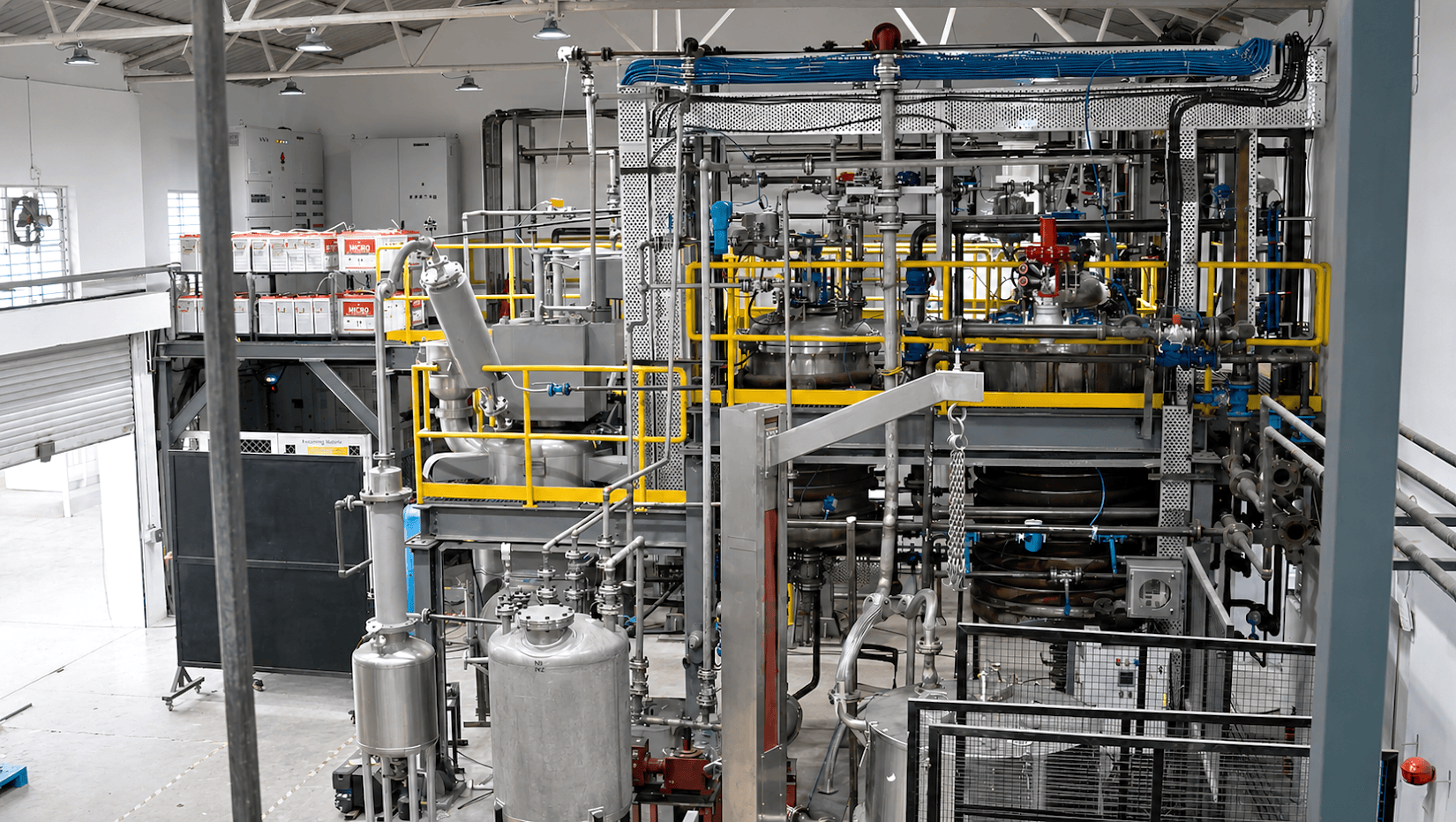
Just as a petroleum refinery cracks crude oil into different fractions so nothing is wasted, altMorph processes agricultural waste through a clean, two-stage architecture :
- Low-Energy Thermochemical Deconstruction
Rather than using slow biological fermentation or energy-guzzling high-pressure reactors, altMorph uses a proprietary thermochemical process to break down raw crop residue into four clean fractions, cellulose, hemicellulose, lignin, and silica. Crucially, the process runs at below 150°C, uses less than 3% chemical inputs, and requires no external pressure. That engineering restraint is what keeps operating costs low and makes the reactor linearly scalable from the lab to a commercial plant.
- Multi-Fraction Upgradation into Drop-In Molecules
In biomass refining, if you only extract one component and throw away the rest, the unit economics never work. altM upgrades multiple fractions simultaneously using thermal, catalytic, physical, and enzymatic routes (backed by 6 PCT patent filings across process chemistry and bespoke reactor hardware).
While the platform has 35+ molecules in its R&D pipeline spanning adhesives, polymers, coatings, and battery anode materials, the team has taken a fiercely disciplined Go-To-Market approach, starting with three high-margin, quick-qualification ingredients in Beauty & Personal Care (BPC) :
- altScreen (Lignin-derived SPF Booster): Sunscreen formulators (the contract labs and brands that design consumer suncare formulas) are stuck in a classic trade-off.
Mineral sunscreens leave a heavy, chalky white cast on the skin, while synthetic chemical UV filters face growing consumer pushback and regulatory bans over possible endocrine disruptions. By upgrading lignin, altM created an SPF booster that allows formulators to cut the amount of UV filters needed while achieving the same SPF rating, eliminating white cast, and improving skin texture. When we spoke to one of India’s leading BPC contract formulators supplying Unilever, Emami, and top D2C brands during our diligence, their verdict was simple: “Nothing in our testing performs as effectively as lignin as a booster.” Even better, priced competitively, it hits the market with zero green price penalty.
- altRheo (Cellulose-derived Rheology Modifiers / Cellulosic Ethers): Accounting for 21% of the active ingredient market, these are the workhorse thickeners and stabilizers that India currently imports 95% of.
altM converts agricultural cellulose into cellulosic ethers, scaling production through a capital-light tolling partnership (using a partner’s manufacturing plant under a profit-sharing agreement rather than locking up heavy upfront capex).
- altAegis (Bio-derived Ferulic Acid): A high-value antioxidant used in premium skincare serums, known for its ability to neutralise free radicals, protect against oxidative stress, and enhance the photostability of other active ingredients, particularly Vitamin C.
altM produces bio-derived ferulic acid by upgrading lignin, offering a cost-competitive, renewable alternative to conventional production routes. This creates an opportunity to serve the growing demand for high-performance antioxidant ingredients in premium skincare formulations.
Why We Invested
In deep-tech materials, the graveyard is full of brilliant lab science that never became a commercial product. Moving a molecule from a 100-gram laboratory beaker to a 100-tonne commercial reactor is where most companies break, as heat transfer changes, batch purity drifts, and capital runs out before customers finish qualifying the material.
What drew us to Apoorv, Yugal, and Dr. Harshad is how intentionally they have engineered around this pilot-to-plant gap :
- Manufacturing DNA Over Pitch-Deck Science: Apoorv and Yugal spent years at Tesla scaling Model 3, Model Y, and Cybertruck manufacturing and supply chains across the US, China, and Germany, while Dr. Harshad actually ran large-scale bioreactors at HPCL. You can see that operational DNA the moment you walk into their Bengaluru facility, where R&D labs, demonstration units (with 400+ completed runs), and pilot manufacturing all sit under one roof. They think about a biorefinery the way Tesla thought about a Gigafactory.
- Demand-Pull Commercialisation: Most deep-tech companies build a massive plant first and hope customers show up later. altM flipped the sequence. On a modest $3.5M seed round, they built their pilot plant, published peer-reviewed validation in RSC Sustainability, and worked directly with domestic BPC formulators to lock in 150 tonnes per annum (TPA) of signed offtake agreements before deploying Series A capex for their commercial units.
- India’s Structural Cost Moat: By combining low cost agricultural residue, low-temperature chemistry, and India’s 4 to 5x lower equipment and construction costs, altM flips the economics of biomaterials on its head. It isn’t decarbonisation that relies on a brand manager’s ESG budget; it is decarbonisation that wins on a procurement manager’s cost sheet.
Every major industrial era has been defined by where its carbon comes from, moving from whale oil to coal, and then to petroleum. We believe the next industrial transition will be built on circular carbon, and India has both the agricultural surplus and the engineering talent to build the global BASF of bio-based specialty chemicals from right here.
Building foundational materials platforms takes patient engineering, long qualification cycles, and perpetual conviction. We are thrilled to back altM as they scale from pilot batches to commercial manufacturing.
