
Introducing FarmWatt Innovations
Every winter North Indian skies turn grey. Millions of tonnes of paddy straw are set on fire across the fields of Punjab, Haryana, and Uttar Pradesh as farmers clear their land for the winter crop. This contributes significantly to the deterioration of air quality.
Why do the farmers do that?
It’s not an act of malice. If he doesn’t burn the stubble he has to spend money on machines and labour to clear the fields in a short window before sowing the winter crops. If you are a farmer who doesn’t have the resources or machinery to clear the stubble, lighting a match is your best option.
So a way to stop this practice would be to ascribe an economic value to this waste.
Here are some numbers to put the scale of this waste in perspective:
- We generate over 500 million tonnes of crop residue every year. Around 120 million tonnes of it is burnt in the fields.
- By weight, we burn crop residue equal to 50% of India’s total petroleum consumption.
- Our surplus crop residue has a power generation potential of 28-30 GW which is around 12% of India’s current peak electricity demand (~250 GW). Out of this mix, rice and wheat straw, if collected properly, can supply nearly 20 GW (around 8–10% of peak power demand)
We have been thinking closely about biogas and its role in India’s energy mix. We wrote about our thesis in detail here.
The short version: India can potentially produce 62 MMT of Compressed Biogas (CBG) annually from domestic organic waste. Right now, we produce less than 1% of that. The policy framework; through the SATAT scheme (which aims for 5,000 CBG plants), the National Bioenergy Programme and the CBG Blending Obligation is now in place. Large capital is also moving in. Companies like Reliance, IOCL, and BPCL are setting up hundreds of plants across the country.
But the bottleneck in Indian biogas isn’t capital or policy anymore. It is feedstock.
Since farm waste is seasonal, bulky, and scattered across millions of small plots, building a perennial supply chain is operationally hard. But this supply chain is absolutely essential for any of these plants to operate at optimum efficiency.
That is why we are investing in FarmWatt Innovations.
What does FarmWatt do?
Founded in 2023 by Kumar Neelendu (Founder and CMD) and Dr. Sachin Sakalle (Co-founder and Head of Projects), FarmWatt is building an agri-waste supply chain and circular economy platform.
They work directly with farmers and Farmer Producer Organisations (FPOs) to collect crop residues along with energy crops like Napier grass, and supply them to CBG, bio-char, and bio-pellet plants.
Their functional unit on the ground is the Farm Urja Kendra. A 10-acre rural collection and processing centre with a capacity of 10,000 to 15,000 tonnes per annum (TPA). Each centre has weighbridges, slashers, rakers, balers, shredders, and storage space. These centers also safely store the feedstock all year round where they have to track moisture levels and prevent fire hazards.
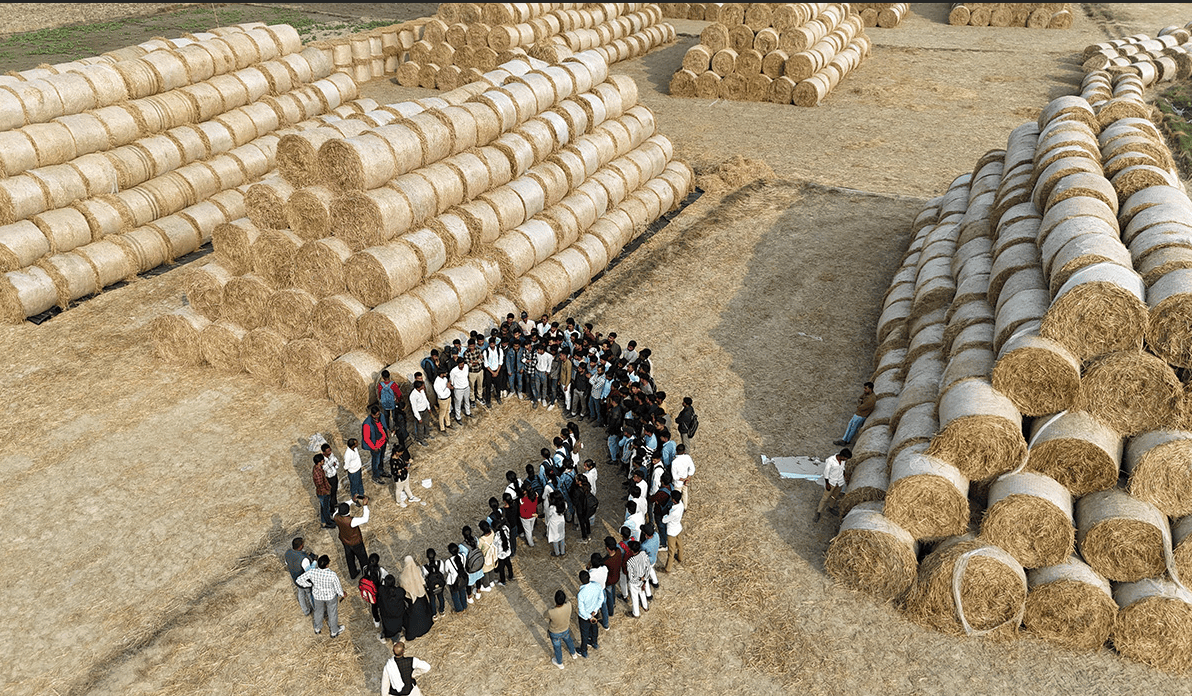
They supply this feedstock under long-term offtake contracts to plant operators like Reliance, IOCL-GPS, and BPCL. Starting with pilots in Prayagraj and Sitapur, FarmWatt now operates across Uttar Pradesh, Madhya Pradesh, Chhattisgarh, Odisha, Haryana, and Rajasthan.
It’s not just about the fuel for these plants. There are other benefits that arise from this supply chain.
- Farmer income: Farmers earn around ₹1.5/kg for crop residue they used to burn.
- Local jobs: Each Farm Urja Kendra employs 50 to 60 locals in tractor operations, baling, logistics, and storage.
- Soil health: The fermented organic manure left over after biogas digestion are channelled back to the same farmer networks cutting down their need for chemical fertilisers and putting organic carbon back into the soil.
A note from the founders
“Every winter, North India breathes the cost of a broken agricultural supply chain. Farmers don’t want to burn straw. After all, their families breathe that same air first, and their own topsoil takes the hit. They burn it because nobody built the logistics to take it off their hands in time for the next sowing.
You cannot fix this problem solely through a digital app. You have to put balers, shredders, and 10-acre storage hubs right next to the villages, work through local FPOs, pay the farmer on the spot, and give biogas plants clean, graded feedstock 365 days a year. With Rainmatter backing us, we have patient capital that understands both energy infrastructure and rural livelihoods. Over the next few years, we plan to scale to 40+ Farm Urja Kendras and manage a million tonnes of agri-waste annually.”
— Kumar Neelendu
Why did we decide to invest?
The stubble burning problem is obvious. What is missing is the will and wherewithal to go into the villages, set up collection centres, aggregate the waste, and deliver it to plants on time.
When we visited Unnao in Uttar Pradesh to see FarmWatt’s collection and processing hubs first-hand, we saw how operationally tough and unglamorous this work is.
With CBG plants getting commissioned across India, feedstock availability will determine which plants thrive and which perish.
What gave us confidence in FarmWatt is the team’s mix of technical depth and rural execution.
Kumar Neelendu has spent years working with biogas technology companies (Rika Biotech, Lehmann-UMT, Weber Entec) and served on the UN FAO Project Audit team in 2023. That is a lot of relevant experience.
Dr. Sachin Sakalle holds a PhD in Agronomy with 23 years of field experience in rural development and value chains.
FarmWatt is taking crop waste that would otherwise choke our cities, paying farmers for it, turning it into clean fuel, and returning organic manure to the soil. That is the kind of practical, ground up work we are happy to back.
