
Introducing Minimac Systems
We are happy to announce our investment in Minimac Systems, a Pune-based company that is building the circular economy for India’s industrial lubricants, one machine and one factory at a time.
The oil nobody talks about
When we talk about India’s oil problem, we often mean fuel. But there is a second, quieter oil economy that keeps every factory, power plant, steel mill, and mine in the country running: lubricants. India is the world’s third-largest lubricant market, consuming over 5 million tonnes of lubricants and greases a year. Over the next five years, India alone is expected to add lubricant demand at a CAGR of 4-5%, accounting for a quarter of all global demand addition.
Here is the uncomfortable part. Every lubricant starts with base oil, and over 60 percent of India’s base oil requirement is imported! An import bill that has crossed $2.7 billion a year. And once used, an estimated 85 percent of this oil is improperly disposed of. Roughly half of all lubricants end up in the environment, burned in the open or dumped, carrying benzene, lead, cadmium, and other toxins with them. A single litre of used oil can contaminate a million litres of fresh water.
So we import the oil at great expense, use it briefly, and then pay for it again in polluted soil and water.
Oil doesn’t wear out, it just gets dirty
The absurdity of this chain becomes clear when you look at what used oil actually is. About 90% of it is still base oil, the valuable part. What degrades are the additives, the sacrificial 5 to 10 percent that protect the oil the way white blood cells protect the body—along with contaminants like metal particles, moisture, and soot that creep in during use.
The oil itself is fine. It is just dirty. Clean it, and it works again. Processing used oil takes roughly a third of the energy needed to refine virgin oil from crude, and where 100 litres of crude yields barely a litre of virgin base oil, 100 litres of used oil can yield around 70 litres of re-refined base oil.
Yet most of India’s used oil never gets this second life. The re-refining industry here is fragmented and largely runs on the outdated acid-clay process, which produces low-quality output and mountains of hazardous sludge. The advanced technologies used globally barely exist in India, and most of the country’s existing re-refining capacity sits underutilised because organised collection of used oil simply does not happen.
The cost of doing nothing shows up on factory floors, too. Industrial downtime costs India over $3 billion annually, and a large majority of it traces back to lubrication failures.
What Minimac does
Minimac’s insight is that lubricant recycling should not require shipping oil to a distant plant. It should happen where the oil lives, inside the plant. The company has spent over a decade miniaturising industrial-grade lubricant recovery technology i.e. filtration, water separation, thin film evaporation, and more into equipment that works at the customer’s doorstep.
Around this, they have built three progressive layers of circularity:
- NanoCircularity extends the life of oil while it is still inside the machine through continuous in-service reconditioning.
- MicroCircularity reclaims and repurposes oil that has been drained.
- MacroCircularity, the next frontier, closes the loop fully through organised collection, reverse logistics, and re-refining used oil back into high-quality base oil.
This translates into a business that earns in two ways.
Minimac designs and manufactures recycling equipment as an Original Equipment Manufacturer (OEM). It also runs services around that equipment, including Recycling on Wheels (RoW)—mobile units that perform doorstep purification and recycling at customer sites— and a newer Lubricant as a Service (LAAS) offering, where customers pay for reliable, managed lubrication as an outcome rather than buying oil and equipment separately. A digitally tracked waste lubricant collection network feeds the loop.
The proof is in the deployment. Since 2012, Minimac has completed over 2,000 projects and put around 2,500 machines in the field, handling everything from 10 litres per minute to 10,000 litres per minute for some of India’s largest power, steel, and manufacturing companies.
Why now
Regulation is finally catching up with physics. India’s Extended Producer Responsibility (EPR) rules for used oil now require that a progressively rising share of base oil feedstock come from recycled sources, from 10 percent today to 50 percent by 2030. An industry that treated used oil as someone else’s problem now has a legal obligation to close the loop, and very little infrastructure to do it with.
Why we invested
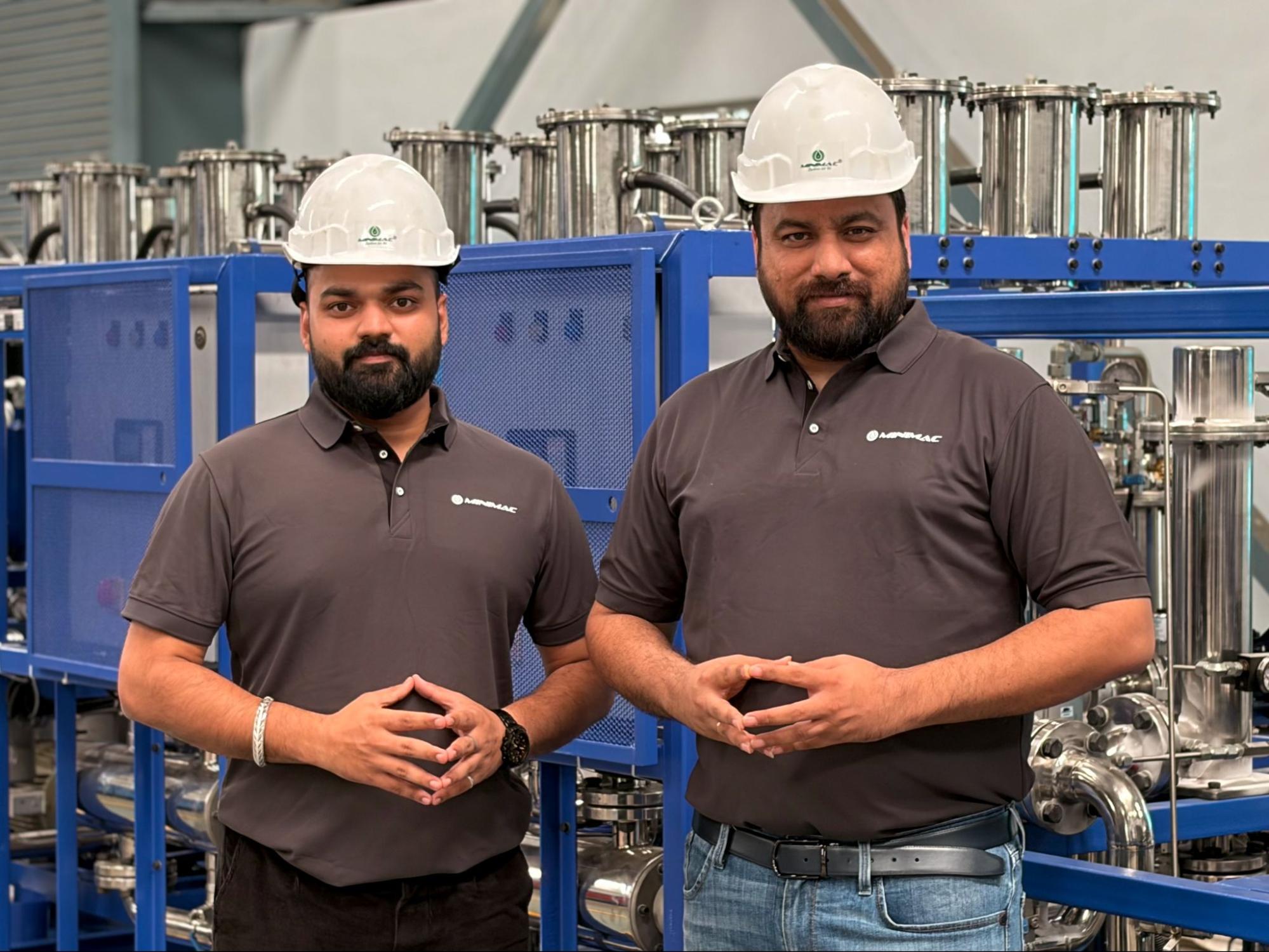
Minimac is the kind of company we find easy to like and hard to find. Anshuman Agrawal, a gold medalist in Mechanical Engineering from IIT-ISM Dhanbad and a management graduate from IIM Indore, has spent well over a decade inside plants understanding how machines actually fail. He and his co-founder Harshit bootstrapped the company from Pune, built it profitably, and earned their expansion the slow way, project by project.
The business sits at an intersection we care deeply about. It reduces import dependence, cuts hazardous waste, extends the life of capital equipment, and pays for itself in avoided downtime. It is decarbonisation that shows up on a maintenance ledger rather than a sustainability report, with a stated ambition to abate 860 gigagrams of CO2 equivalent by 2034.
Our capital will help Minimac deepen its recycling technology, expand its doorstep services footprint, and work toward the re-refining capability that completes the circle. This is patient work, and we are glad to be along for it.
You can learn more about Minimac at minimacsystems.com.
