
Introducing Aurassure
The last few years have made something clear: climate volatility is no longer an exception; it’s the new operating environment for our cities. Flooding after routine rainfall, heatwaves that push public systems to their limits, and air quality that shifts dangerously within hours have exposed a simple truth: urban resilience is now a real-time challenge.
Climate risks don’t occur in isolation. Poor air quality affects health and productivity, heatwaves strain energy systems, and local flooding disrupts mobility and damages infrastructure. When these events overlap, their impact multiplies. Cities need more than monitoring, they need live climate intelligence that can sense, predict, and guide action at a neighbourhood level.
Climate intelligence will become a foundational layer for urban governance and industrial growth and this is where mission-driven innovation matters. We want to back founders who are building the future of climate resilience. We know this kind of systemic change doesn’t happen overnight. It demands patient capital, trusted partnerships, and a shared commitment to protecting both people and infrastructure.
Aurassure is one such company leading this shift. Their climate intelligence platform provides real-time visibility into air quality, flooding, heat stress, and extreme weather, enabling governments, enterprises, and developers to act before situations escalate.
What sets them apart is the ability to turn environmental signals into actionable decisions that improve public health, strengthen infrastructure, and support smarter urban planning.
As cities adapt to a more unpredictable climate reality, platforms like Aurassure will form the foundational layer for safer, healthier, and more resilient urban futures.
What do they do?
Aurassure is a climate technology company that transforms raw environmental signals into real-time, operational intelligence for cities, enterprises, industries, and communities. The platform integrates hyperlocal IoT monitoring, cloud analytics and AI-based forecasting to build a continuous, ground-up understanding of climate risks such as air pollution, heat stress, rainfall variability, and urban flooding.
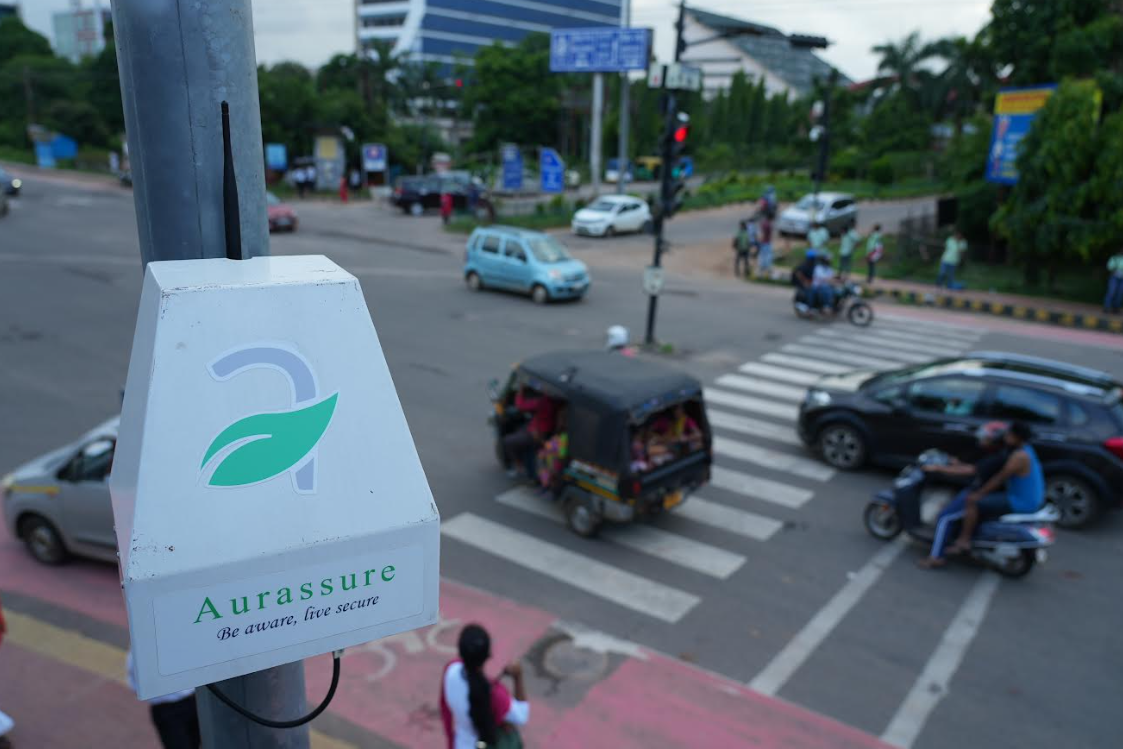
It designs and deploys dense, hyperlocal sensor networks that capture high-resolution data on the parameters that matter most: particulate matter (PM₁, PM₂.₅, PM₁₀), gases (NO₂, SO₂, CO, O₃), greenhouse indicators (CO₂, CH₄), weather variables (temperature, humidity, wind, radiation), and hydrological markers (water levels, flow, precipitation). This data flows into a cloud platform where advanced AI models analyse patterns, detect anomalies, and convert raw measurements into early warnings, risk indices, predictive trends, and actionable insights.
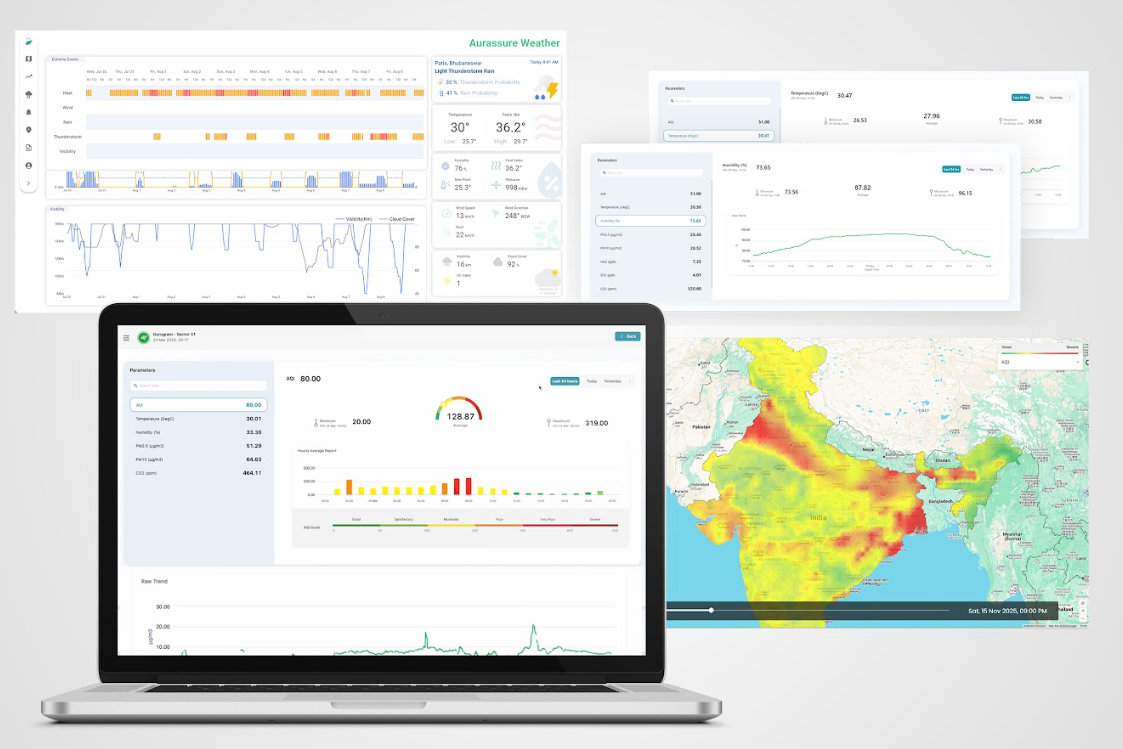
Beyond visualization, the system is designed for foresight. Aurassure’s dashboards interpret complex environmental behaviour and translate it into operational intelligence that helps organizations anticipate risks, adjust workflows, and protect people and assets. For example, employers can reduce heat exposure and manage poor air days more safely; enterprises and industries can ensure regulatory compliance and climate-risk preparedness; and governments can improve planning, enforcement, and public safety. At the community level, neighbourhood-level insights support awareness and informed daily choices.
Aurassure’s climate intelligence systems have been deployed at scale across 200+ cities in India and 100+ cities in Brazil, as well as multiple industrial facilities, corporate campuses, educational institutions, and infrastructure corridors. Built to be modular, rugged, and affordable, their devices operate reliably across diverse climates, from humid coastal zones to dry heat regions, making the solution suitable for both emerging and developed markets.
By combining advanced monitoring with predictive analytics, Aurassure offers a complete climate intelligence stack that supports safer operations, healthier environments, and long-term climate adaptation. The platform enables organizations to strengthen climate resilience and contribute to global Sustainable Development Goals, including SDG 3 (Good Health & Well-being), SDG 11 (Sustainable Cities & Communities), and SDG 13 (Climate Action).
The company is driven by a strong founding and core team with Akanksha Priyadarshini, who leads the overall vision and strategy, Vamsi Krishna, who leads technology and oversees the data and AI architecture that powers the platform, Omprakash Patra, who leads embedded systems and firmware development, Raviteja Cherukuri, who leads hardware design and sensor engineering, Satyanarayan Bishoyi, who leads operations and large-scale deployments and Dr. Asutosh Acharya, who leads scientific research in climate and atmospheric science.
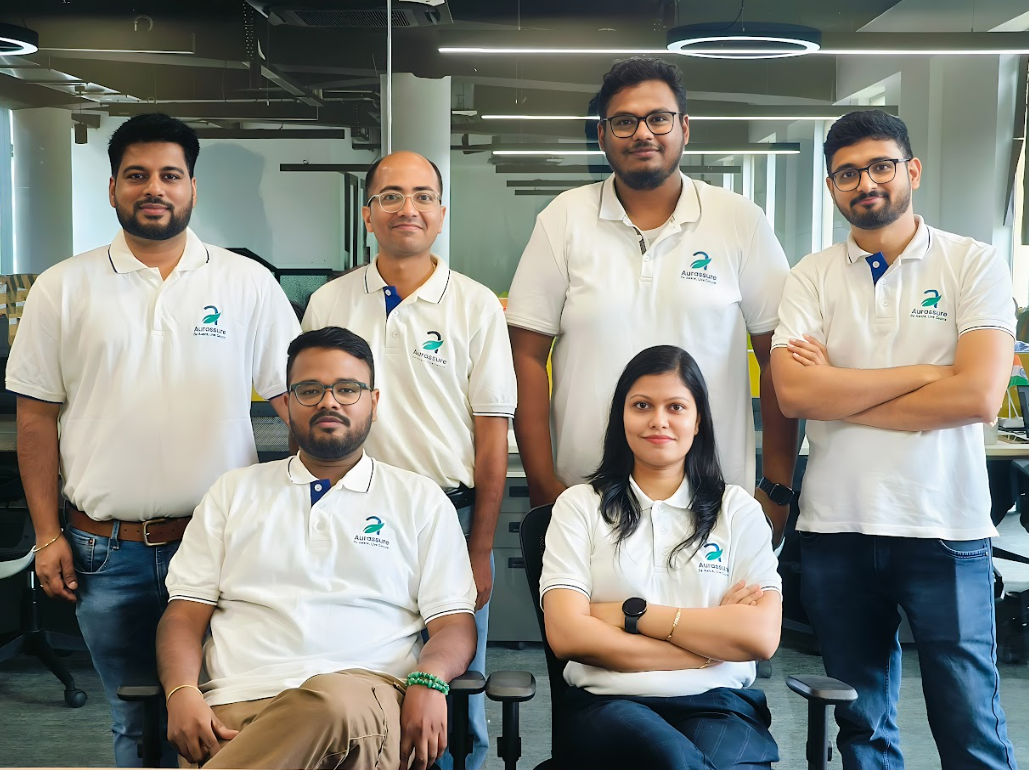
Together, they combine engineering depth, scientific rigor, and on-the-ground execution to build reliable climate intelligence for cities and enterprises.
Environmental impact
Aurassure’s networks provide deep visibility into environmental behaviour, helping cities and enterprises understand pollution dynamics, enforce green construction practices, guide mobility planning, and design evidence-based climate interventions. Real-time rainfall, runoff, and water-level insights strengthen preparedness for local flooding, while intelligent HVAC optimization reduces indoor emissions and energy consumption. Their data supports afforestation planning, zoning decisions, and long-term environmental management by offering a granular view of how climate patterns evolve across regions.
Social impact
At the social level, Aurassure transforms invisible climate risks into trusted information that helps people stay safe. Timely alerts on heat stress, heavy rainfall, and air pollution help protect frontline workers and vulnerable groups like elderly, pregnant women, children, etc. In homes, schools, and public spaces, neighbourhood-level insights enable families, educators, and local governments to adjust routines and implement protective measures. Across India and Brazil, Aurassure’s deployments provide communities with transparent, easy-to-understand environmental intelligence, strengthening awareness, preparedness, and everyday decision-making.
Why did we decide to invest in them?
As we studied the climate-intelligence landscape, one thing became clear: while many solutions offer scattered data, very few can translate environmental behaviour into intelligence that cities and enterprises can act on. What stood out about Aurassure was their ability to bridge this gap with both scientific depth and on-the-ground practicality.
Their approach is grounded in something we value deeply: building from first principles. Instead of relying solely on satellite models or theoretical forecasts, Aurassure has invested in creating dense, hyperlocal sensing networks and pairing them with robust AI-physics models. This combination provides the kind of accuracy and reliability that real-world decision-making demands.
We appreciate the team’s ability to deploy at scale across varied geographies, humid coasts, dense metros, flood-prone corridors, and heat-stressed regions. This kind of execution strength is rare, especially in climate tech, where hardware, data science, and operational complexity converge.
Aurassure represents the kind of work Rainmatter is committed to; supporting solutions that are scientifically grounded, operationally feasible, and capable of creating real impact for millions of people.
Here is a note from Akanksha talking about their journey, business and future plans:
Aurassure began in 2022, shaped by years of my experience working with Smart Cities during my previous venture. During that time, one pattern became impossible to ignore: cities were making critical decisions with environmental data that was either outdated, too broad, or simply unavailable. Air quality fluctuated by the hour, rainfall and flooding varied street by street, and climate risks were becoming more frequent, yet the systems meant to monitor them were not built for this new reality.
That gap is what led us to start Aurassure. We wanted to create a climate intelligence layer that could give cities and enterprises real-time, hyperlocal visibility into the environment around them, not just for analysis, but for action.
Our small beginning became a turning point when Google invited us to demonstrate a hyperlocal air-quality network in Bhubaneswar as part of their early Air View+ work in India. We built a hybrid system with environmental sensors across neighbourhoods as well as monitors on public buses in partnership with CRUT (Capital Region Urban Transport), creating a dynamic hyperlocal map of the city’s air.
That small beginning sparked a much larger movement. The data opened up conversations with researchers, municipal agencies, and pollution boards. We published analyses revealing the real nature of pollution hotspots and temporal patterns, insights that could finally guide targeted, data-backed action.
What started as a pilot quickly expanded across hundreds of cities across India and Brazil, each with its own environmental challenges and governance needs.
As we grew, so did the applications of our platform. Industries began using Aurassure to automate environmental controls and improve worker safety. Builders and infrastructure developers relied on our data to meet compliance norms, avoid penalties, and operate more responsibly. Cities used our hyperlocal intelligence to strengthen enforcement, guide clean mobility plans, and design low-emission zones. Flood-prone regions used our rainfall and water-level data to coordinate faster, more informed responses. Schools, campuses, and communities embraced real-time dashboards to make safer, more conscious everyday decisions.
Over time, our purpose became clearer: Aurassure is not just about monitoring, it’s about shifting entire systems from reaction to resilience.
This work has shaped how cities plan green corridors, how industries adopt cleaner operations, how local governments design microclimate strategies, and how communities understand the environment around them. Each deployment has reinforced the same truth: meaningful climate resilience begins with visibility.
Where We’re Headed
The impacts of climate change are deeply unequal, felt most intensely across the Global South, where dense populations and limited infrastructure collide with rising environmental volatility. This is where our work is most needed, and where we are committed to building.
Our next chapter is defined by a bold and simple vision: to enable hyperlocal climate intelligence in 1,000 cities across the Global South in the next 3 years.
We want every street, every neighbourhood, and every critical facility to have real-time environmental visibility. We want cities to predict floods before they paralyse roads. We want workers to be warned before heat stress harms their health. We want schools, hospitals, and communities to breathe safer air. And we want governments and enterprises to plan with clarity, not uncertainty.
To make this a reality, we’re strengthening three core pillars:
- Scale: Expanding dense sensor networks across Asia, Latin America, and Africa.
- Intelligence: Advancing AI models that blend environmental science with urban behaviour.
- Accessibility: Making climate data a public good that supports everyday decision-making.
We believe the cities of the future will not be defined by their size or skylines, but by how intelligently they manage climate risks. And we are building the systems that will help them get there.
