


November 25, 2026
Changed jobs? Don’t forget to transfer your provident fund balance
Satya Sontanam | Personal Finance
If you are a salaried employee covered under the Employees’ Provident Fund (EPF), typically, both you and your employer contribute 12% of your basic salary and dearness allowance towards your retirement savings. Your share is deducted from your salary every month, while your employer makes a separate contribution. A portion of your employer’s contribution may go towards the Employees’ Pension Scheme (EPS).
You may already be familiar with the Universal Account Number (UAN) allotted to you by EPFO. This number remains the same even when you change jobs. But just because you have one UAN doesn’t mean all your PF savings are sitting in one account.
Every time you join a new organisation covered by EPFO, your employer can create a separate PF account, identified by a member ID, under the same UAN. So, if you’ve worked with four organisations over the last 10 years, you could have four separate PF accounts linked to your UAN.
Ideally, your PF balance from your previous employment should automatically get transferred to your current account when you change jobs. But this doesn’t always happen. So, it’s worth checking whether the money from your previous accounts has been transferred. If not, here’s how you can do it.
How to transfer your PF balance
Sign in to the EPFO Member Portal using your UAN and password.
- Go to ‘Online Services’ and select ‘Transfer Request’.
- You will see the details of your current employer and the PF account linked to that employer.
- To transfer the balance from your previous PF account, enter the member ID of your previous employer and retrieve the account details.
- If you don’t know the member ID, you can find it in your PF passbook or check your payslips from your previous organisation.
- Verify the details of your previous PF account.
- Request and enter the OTP sent to your Aadhaar-linked mobile number.
- Submit the transfer request.
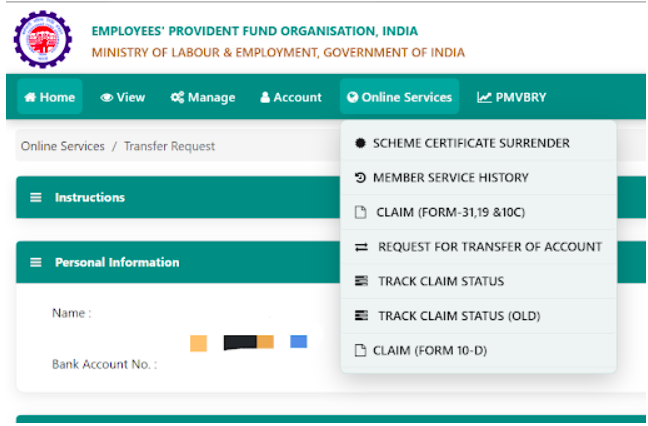
You can follow the progress of your request under ‘Track Claim Status’ on the portal. If you have multiple PF accounts whose balances haven’t been transferred, repeat the process for each of them.
Do you need approval from your previous employer? Usually, no. EPFO has removed the requirement for employer approval in most transfer cases. However, if there are discrepancies in your employment details, such as your name or your dates of joining and leaving the organisation, you may need to get them corrected. Some corrections can be made directly through the portal, while others may require a joint declaration and verification by your previous employer. In such cases, you will need to coordinate with your previous organisation.
EPFO’s published timeline for settling a complete transfer claim is 20 days. Once the transfer is complete, check whether the transferred amount appears as a credit in your current PF account’s passbook. If a complete transfer request remains pending beyond 20 days, you can raise a complaint through EPFO’s grievance portal.
What happens if you don’t transfer your PF balance?
Apart from having your retirement savings scattered across multiple accounts, not transferring your PF balance can have implications for your withdrawals, pension and taxation.
Withdrawals: While PF is meant for retirement, you can withdraw a portion of your savings during your working years for certain purposes. The amount you are eligible to withdraw can depend on the balance in your PF account. Say you have ₹4 lakh in your previous PF account and ₹2 lakh in your current account. Transferring your previous balance would bring your current account balance to ₹6 lakh, potentially increasing the amount you can withdraw, subject to the applicable withdrawal rules.
Pension: If you are covered under the Employees’ Pension Scheme (EPS), you generally need at least 10 years of eligible service to qualify for a monthly pension. Say you worked with one organisation for six years and another for five years. While neither employment individually meets the 10-year requirement, your combined service of 11 years could qualify you for a monthly pension. When you transfer your PF account, your previous pensionable service is also carried forward. Remember, unlike your PF savings, it is your service history that gets carried forward under EPS, not an individual pension balance.
Tax: Withdrawing your PF savings before completing five years of continuous service may attract tax. However, these five years need not be with the same employer. Say you worked with your previous employer for three years and your current employer for four years. If you transfer your previous PF balance, the combined seven years of service can be considered towards meeting the five-year requirement.
But does your old PF account stop earning interest if you don’t transfer it? No. Changing jobs or leaving your PF balance untransferred does not, by itself, stop interest. Your balance continues to earn interest until the account becomes inoperative under EPFO’s rules. This generally happens after retirement, depending on your age and circumstances.
Conclusion
The next time you change jobs, apart from checking whether your new employer has started making PF contributions, also check whether the savings from your previous employment have been transferred to your current account.
You can check your PF accounts and balances through the EPFO website or the UMANG app. On 1 November 2026, EPFO also launched a WhatsApp service that allows members to check their PF balance, view their last five transactions and download their passbook without opening the EPFO website.
Even if you’ve changed several jobs in the past, it’s worth taking a few minutes to check whether all your PF savings have been brought into your current account.