


July 27, 2026
Understanding the New EPF Rules: The ₹1,800 Cap Explained
Satya Sontanam | Personal Finance
Under the new EPF rules, your monthly provident fund contribution can be limited to ₹1,800, even if 12% of your basic salary plus Dearness Allowance (DA) comes out to a much higher figure. Your employer’s contribution can also be capped at the exact same limit.
For many salaried individuals, limiting this deduction could increase their monthly take-home pay. Alternatively, you can choose to continue making higher contributions toward your long-term retirement goal.
Here is a simple breakdown of what the new EPF rules mean, how the math works, and the choices available to you.
What Do the New EPF Rules Say?
Currently, many organizations calculate the Provident Fund contribution as 12% of your actual basic salary plus DA. The employer matches this amount with an equal 12% contribution from their side.
For example, if your basic salary plus DA is ₹50,000 per month:
- Your contribution (12%): ₹6,000
- Employer’s contribution (12%): ₹6,000
- Total monthly PF deposit: ₹12,000
In this standard scenario, a total of ₹12,000 is moved into your EPF account every month.
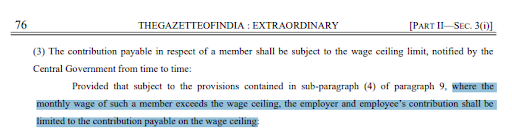
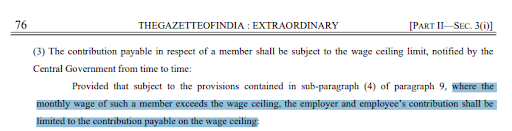
The new EPF rules clarify that mandatory contributions are capped at 12% of the statutory “wage ceiling”. As per government notification, the current statutory wage ceiling stands at ₹15,000 per month.
Calculating 12% of this ₹15,000 wage ceiling yields a mandatory monthly contribution of exactly ₹1,800.
Therefore, under the new EPF rules, the mandatory provident fund contribution for both the employer and the employee is capped at ₹1,800 per month.
The updated rules also emphasize that if someone earns above ₹15,000 per month and has never been an EPF member before, they are treated as an “excluded employee”. Participating in the EPF scheme is not compulsory for them.
However, if you are already an active EPF member, your membership continues seamlessly even when your wages cross ₹15,000. What changes is that the mandatory contribution amount can now be capped at the ₹1,800 limit.
To understand the real-world impact, let us revisit the example of an employee earning a basic salary plus DA of ₹50,000 per month.
Current Method (12% of Actual Basic Salary)
- Employee contribution: ₹6,000
- Employer contribution: ₹6,000
New Method (Capped at Wage Ceiling)
- Employee contribution: ₹1,800
- Employer contribution: ₹1,800
By capping both contributions at ₹1,800, the monthly amount sent to the PF account drops by ₹4,200 on the employee’s side and ₹4,200 on the employer’s side.
From a payroll perspective, this reduction means your pre-tax take-home salary could increase by up to ₹8,400 per month.
Interestingly, the ₹1,800 limit and the requirement for a joint written request are not entirely new concepts.
Even under earlier framework guidelines, contributing on a basic salary higher than the statutory wage ceiling required a joint written request from both the employee and the employer. The recent updates simply make this default position much clearer across payroll implementations.
What Are Your Options Moving Forward?
With these clearer guidelines in place, salaried employees broadly have a few ways to structure their contributions:
- Submit a Joint Request: You and your employer can jointly opt to continue contributing 12% on your actual, higher basic salary.
- Use the Voluntary Provident Fund (VPF): You can cap the regular PF contribution at ₹1,800 and choose to contribute extra funds from your side via VPF. Your employer is not obligated to match your VPF contribution.
- Invest the Difference Independently: You can restrict the mandatory PF contribution to ₹1,800 and take the remaining balance as cash flow to invest in other financial instruments independently.
- Explore Mutual Fund Salary Deductions: SEBI has proposed allowing employees to invest directly in mutual funds through automated salary deductions. Once introduced and adopted by organizations, this could provide an extra avenue for individuals seeking higher equity exposure.
Moving forward, flexible compensation structuring is likely to become a key trend across organizations.
Rather than enforcing a single company-wide rule or making a 12% deduction on full basic salary compulsory for everyone, progressive HR and payroll policies may give employees the power to choose. Since the rules require consent to contribute above the ₹15,000 ceiling, companies may incorporate this choice directly into their onboarding documentation or annual CTC declaration portals.
Employees who need immediate liquidity or a higher monthly take-home salary can select the ₹1,800 cap. Conversely, employees who prioritize long-term compounding and structured tax savings can choose to keep contributing 12% of their actual basic salary.
Conclusion
The updated guidelines surrounding the new EPF rules bring clearer choices to salaried professionals. Whether you choose to maximize your monthly cash flow or maintain disciplined retirement contributions depends on your personal financial goals, current cash needs, and overall investment strategy.
Regardless of the option you choose, taking ownership of your long-term retirement planning remains the most crucial step.