


July 17, 2026
How Global Parent Earnings Drop Clues for Indian Stocks
Akshay Navin | Stock markets
When a company’s stock price shoots up by 10% in a single day, you would naturally assume that the company just announced stellar quarterly earnings or landed a massive new contract.
But sometimes, a stock moves sharply without releasing any news of its own.
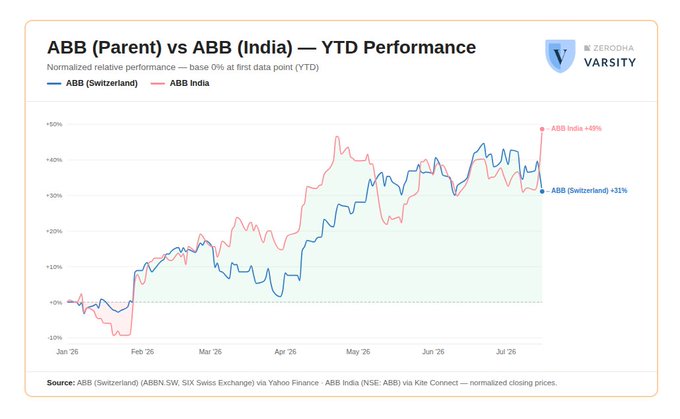
This is exactly what happened with ABB India recently. The stock jumped as much as 10% in a single trading session, hitting close to its 52-week high. Interestingly, the trigger did not come from the Indian company’s own financial results. Instead, it came from a single slide in the second-quarter report published by its Swiss parent company, ABB Group.
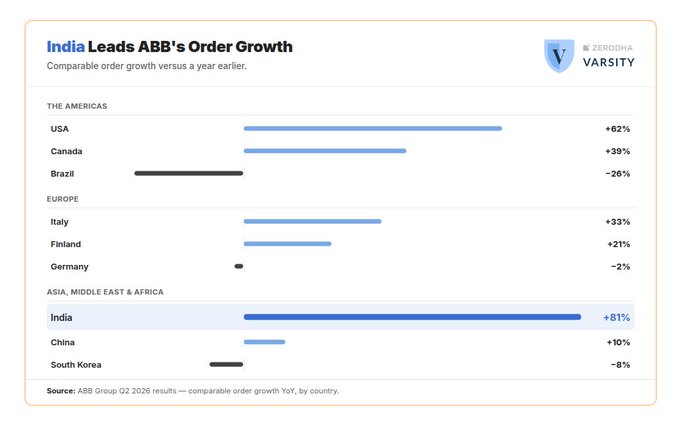
The standout number that caught everyone’s attention was ABB Group’s order intake from India, which grew by a massive 81% year-on-year.
The Core of India’s Industrial Growth
To understand why the market reacted so strongly to this number, you have to look at what the company does. ABB India sits right at the center of the country’s industrial capital expenditure (capex) cycle.
The company has operated in India for over a century. It runs six manufacturing locations and divides its operations into three primary business areas:
- Electrification: Managing power distribution and manufacturing switchgear.
- Motion: Producing industrial motors and drives.
- Automation: Developing process control systems.
Together, these business segments serve critical infrastructure sectors, including metro rails, railways, metals, cement, renewable energy, and commercial buildings.
The Data Center Boom
One of the fastest-growing segments for the company is data centers. In a recent earnings call, management revealed that data centers now make up about 12% to 16% of the company’s total order book.
ABB provides the essential electrical backbone required to run these facilities. This includes switchgear to bring power into the facility, Uninterruptible Power Supplies (UPS) for electrical protection, and the specialized motors and drives needed to keep the systems cool. For context, the company’s key orders in the previous quarter included major projects for both a data center and a metro rail network.
This industrial momentum explains why the Swiss parent’s recent update immediately grabbed the attention of Indian investors. The global group itself reported a strong quarter, with record orders of $12.0 billion (up 28%), revenue of $9.5 billion (up 12%), and an operating margin of 20.2%. Yet, the single metric that domestic investors focused on was the 81% surge in India-specific orders.
Understanding Orders vs. Revenue
Before drawing conclusions from a massive jump in orders, it is important to clarify a key accounting concept: orders are not the same as revenue.
Orders represent future business that is entering the company’s pipeline. While a sharp jump in order intake strongly signals that revenue could grow in the coming quarters, it is not an absolute guarantee. The work still needs to be executed and billed before it officially counts as revenue.
The Parent-Subsidiary Relationship
Many well-known companies listed on the Indian stock exchanges (NSE and BSE) share this exact corporate structure. They operate as majority-owned subsidiaries of large, multinational corporations. The global parent company manages operations worldwide, while the Indian arm is listed locally for domestic investors to trade.
Here are a few prominent examples of Indian companies and their global parents:
| Indian Subsidiary Stock | Global Parent Company |
| ABB India | ABB Ltd (Switzerland) |
| Hyundai Motor India | Hyundai Motor (South Korea) |
| Siemens India | Siemens AG (Germany) |
| Bosch India | Bosch (Germany) |
| Nestlé India | Nestlé SA (Switzerland) |
| Hindustan Unilever (HUL) | Unilever (UK) |
An Early Glimpse for Investors
These global parent companies publish their consolidated financial results based on their own reporting calendars. Because they oversee global operations, they frequently break down their performance by specific regions or individual countries.
Since the parent company consolidates the financial data of all its global business units, these international filings can give smart investors an early clue about local demand, order momentum, and business health long before the Indian subsidiary reports its own numbers.
This means you can occasionally get a clear preview of an Indian subsidiary’s underlying business trends ahead of its official domestic earnings release.
With ABB India scheduled to report its official local earnings on July 31, the stock’s recent double-digit jump suggests that the market has already started pricing in what that massive 81% order growth could mean for the company’s future financial performance.