


October 13, 2026
Post Office vs Bank FD vs Arbitrage Funds: Which is better?
Satya Sontanam | Uncategorized
Post Office schemes pay more than large-bank FDs on paper, but that is not the full picture. Compounding, interest payout and tax can flip the winner. Read on to see which one actually gives better returns in your pocket.
How the repo rate affects FD and loan rates?
Whether it is the EMI on your home loan or the interest on your fixed deposit, most interest rates in the country trace back to one number: the repo rate. It is one of the biggest forces influencing interest rates across the country, and the RBI sets this rate based on the state of the economy.
When it moves, everything else follows. When the RBI raises it, loans get expensive and you earn more on your fixed deposits. When the repo rate is cut, both loan rates and fixed deposit rates fall.
In the last year and a half, the repo rate has been falling. It was at 6.5% at the start of 2025. By December 2025, it had come down to 5.25%, and it has stayed there through 2026. Accordingly, banks have been lowering FD rates. If you recently renewed an FD, you have probably felt it.
Post Office scheme rates vs bank FD rates
But you know what? The rates on Post Office schemes did not budge. Returns from schemes such as Time Deposits and National Savings Certificates have remained unchanged since January 2024. (See the note above on the NSC date.)
Current Post Office rates
| Scheme | Tenure | Rate | Unchanged since |
|---|---|---|---|
| Time Deposit | 1 year | 6.9% | 1 January 2024 |
| Time Deposit | 2 years | 7.0% | 1 January 2024 |
| Time Deposit | 3 years | 7.1% | 1 January 2024 |
| Time Deposit | 5 years | 7.5% | 1 January 2024 |
| NSC | 5 years | 7.7% | April 2023 |
Are Post Office schemes safer than bank FDs?
If you think about it, this is actually a bit odd. Post Office schemes carry a full government guarantee. On the other hand, banks give you only ₹5 lakh of deposit insurance through DICGC (Deposit Insurance and Credit Guarantee Corporation).Going by the basic rule of risk and reward, the riskier option should pay more. Banks should be offering higher rates than the Post Office, not the other way around. And yet, look at the numbers.
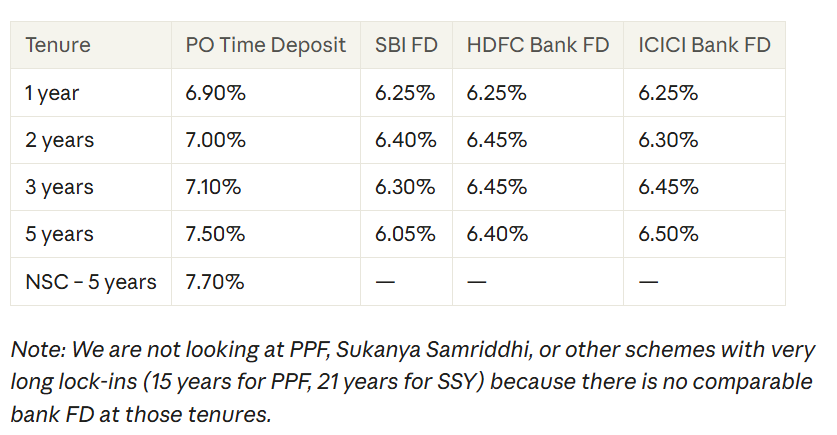
Small finance banks would offer higher rates, but among the large banks compared to PO schemes, the latter wins. Clearly, So the decision looks easy. Higher rate & government guarantee; just go to the Post Office, fill out the form, done.
Except, it’s not.
What to check before comparing fixed-income products
There are three things you need to look at before you compare any two fixed-income products:
- How the interest compounds
- How the interest is paid out to you
- How much of it the government takes as tax
Each one of these can change who wins.
Factor one: how the interest compounds
When a bank says your FD earns 7.5%, it is natural to think your ₹1 lakh would earn about ₹7,500 in the first year.
But bank deposits are usually quarterly compounded. That means the interest on your FD is calculated every three months at the rate of 7.5% per annum. Each quarter, that interest gets added to your principal, and the next quarter you earn interest on a slightly bigger amount. So you end up earning a little more than ₹7,500 in the year 1 (about ₹7,714).
Most Post Office schemes also work on quarterly compounding. But NSC, one of the most popular and highest-return Post Office schemes, compounds only once a year.
Say a small finance bank is offering an FD at 7.6% (quarterly compounding) and NSC at 7.7% (annual compounding). At the end of five years, what you earn on the FD at 7.6% would actually be slightly more than what you get from NSC at 7.7%.
The difference may not be significant, but the point is that a lower rate that compounds more often can match or beat a higher rate that compounds less often. Do not just go by the headline rate.
Factor two: how the interest is paid
This one gets almost no attention.
When you put money in a cumulative bank FD, the interest stays inside the deposit until it matures. And the interest already earned keeps earning more interest.
A Post Office Time Deposit works differently. It calculates interest the same way. But once a year, it takes that interest out and credits it into your savings account.
Why does this matter? Because that interest sitting in a savings account earns just 4%, instead of 7.5% if it had stayed in the deposit.
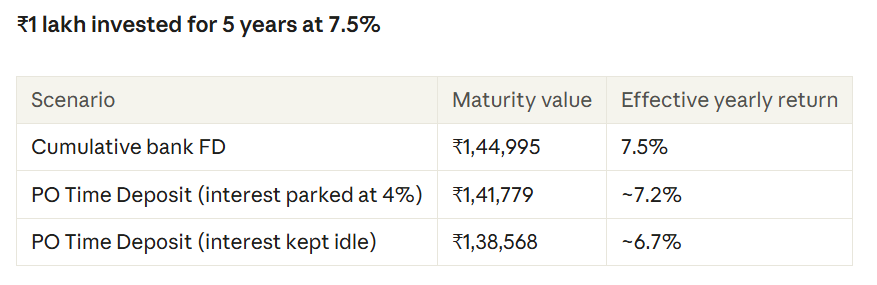
So when you are comparing Post Office Time Deposits and FDs, keep this point in mind.
Factor three: tax
This is the biggest one. It can flip the winner entirely.
Interest from bank FDs, Post Office Time Deposits, and NSC is added to your income and taxed at your slab rate every year.
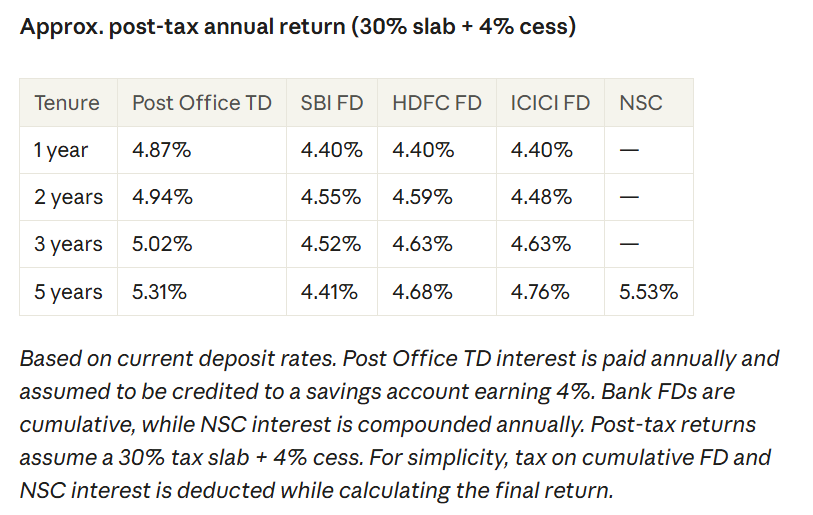
If you are in the 30% bracket (plus 4% cess), out of every ₹100 of interest you earn, about ₹31 goes to the government.
The section 80C tax benefit extended for Post Office schemes, as per the old tax regime, is not available here.
See the table below for what post-tax returns actually look like at the 30% slab.
Arbitrage funds as a tax-efficient alternative
This is where arbitrage funds come in. They do have exposure to equity markets and do not come with a guaranteed return, but they are one of the less risky mutual fund categories out there.
It behaves like a debt product, but is taxed like an equity product.
How are arbitrage funds taxed?
If you hold for more than 12 months, your gains are taxed at just 12.5% (plus cess), and the first ₹1.25 lakh of such gains per year is completely tax-free. Compare that to the 30% you pay on FD interest. That is the difference.
For example, if an arbitrage fund gives you about 6% after tax, a fixed deposit or term deposit would need to offer you about 8.7% before tax to match that at the 30% slab. That’s a big difference in the fixed income space.
The interest you earn becomes so low that it hardly beats the country’s inflation rate.
Arbitrage funds vs Post Office Time Deposits since 2013
We also went back to 2013 and checked how arbitrage funds actually did against the Post Office TD rates available at the same time.
The interesting bit was that before tax, Post Office Time Deposits often looked better. But after tax, arbitrage funds came out ahead in most 1, 2, and 3-year periods for someone in the 30% tax bracket.
For a five-year tenure, arbitrage funds remained competitive with NSC scheme. NSC had one big advantage: you knew your return from day one, which is not the case with mutual funds.
A big reason was the tax. Time Deposit interest gets taxed at your slab rate every year, while arbitrage funds get equity taxation if you hold them for more than 12 months.
So, what to choose?
Post Office Time Deposits vs bank FDs
While Post Office schemes, especially the Time Deposits across different tenures, look superior on the face of it compared to bank FDs, the quarterly compounding and cumulative nature of bank fixed deposits can narrow the gap considerably.
On top of that, Post Office schemes come with less ease of access and stricter withdrawal restrictions, so when you factor those in, bank FDs may actually edge out.
Best option for a 5-year lock-in in a higher tax bracket
If you are in a higher tax bracket and can lock your money away for five years, NSC still looks like a good option. Higher rate, interest stays invested until maturity, return locked on day one. Arbitrage funds are not a bad choice either. Going by the past, arbitrage funds have roughly matched NSC after tax at the 30% slab, but NSC gives you certainty.
Best option for 1–3 year tenures in the highest tax bracket
For tenures of 1-3 years, for investors in the highest tax bracket, our historical comparison shows that arbitrage funds become particularly competitive; beyond 12 months, their tax treatment becomes especially favorable.
What about debt mutual funds?
And if you are looking at debt mutual funds, the same rule applies: always check the post-tax expected return, not just the headline number. Since April 2023, all debt fund gains are taxed at your slab rate, so the tax advantage that debt funds once had is gone.
Bottom line
The headline rate is what you see. But the rate that matters is the one that lands in your pocket after compounding, payout structure, and tax have had their say. Those three things are never printed on the brochure upfront, and they can completely change the answer.
Why are Post Office rates still high when FD rates are falling?
The government is supposed to follow a formula while setting small savings rates. It looks at government bond yields and generally adds a small extra return on top. That extra return could partly be to compensate for the lower flexibility of these post office schemes.
That said, several small-savings schemes are paying more than this formula would suggest because the government decided to keep the rates unchanged for reasons we may not fully understand.
Of all schemes, NSC currently has the highest premium relative to the formula’s suggested rate. PPF, on the other hand, is roughly in line with the formula.