


July 29, 2026
Understanding Bank Nifty: Composition, Volatility, and Trading Options
Akshay Navin | Futures & Options
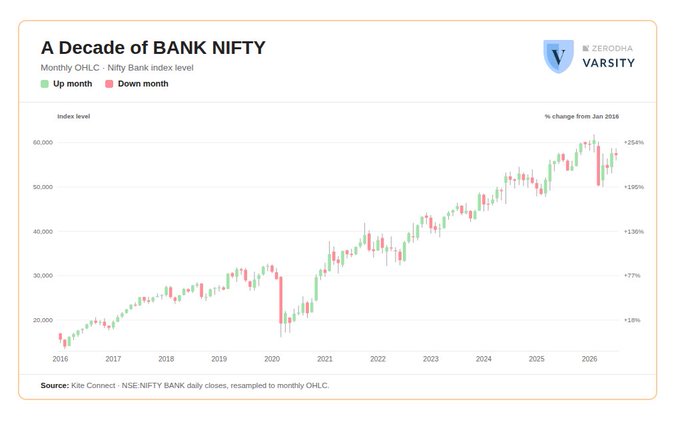
Bank Nifty was launched in 2003 to track the performance of top banking stocks in India. Over the years, it has grown significantly and currently trades near 57,000—marking a rise of almost 200% over the last decade.
Along this journey, it has evolved into one of the most heavily traded derivative contracts in the Indian financial markets. As an index that tracks the backbone of the Indian economy, understanding how Bank Nifty works provides valuable insights into both sector movements and market dynamics.
The Composition of Bank Nifty
While Bank Nifty consists exclusively of banking stocks, the nature of these institutions varies considerably. The index brings together different banking models under a single umbrella:
- Private Sector Banks: Industry leaders like HDFC Bank and ICICI Bank dominate the index, accounting for roughly 72% of the weightage.
- Public Sector Undertakings (PSU Banks): State-owned lenders like State Bank of India (SBI) and Bank of Baroda make up about 23%.
- Small Finance Banks: The remaining 5% is allocated to small finance banks.
The index weightage is heavily concentrated among its top constituents. HDFC Bank and ICICI Bank together account for approximately 33%—or one-third—of the entire index. Furthermore, the top five constituent banks command nearly 66% of the total weightage.
Because of this heavy concentration, volatile price action or quarterly earnings announcements from just one major bank can create significant movement across the entire index.
Contract Specifications and Expiry Rules
Understanding the derivative contract parameters is crucial before trading Bank Nifty options or futures.
Under SEBI’s framework allowing only one weekly expiry per exchange, the National Stock Exchange (NSE) transitioned Bank Nifty to a monthly-only expiry cycle. These monthly contracts expire on the last Tuesday of the month.
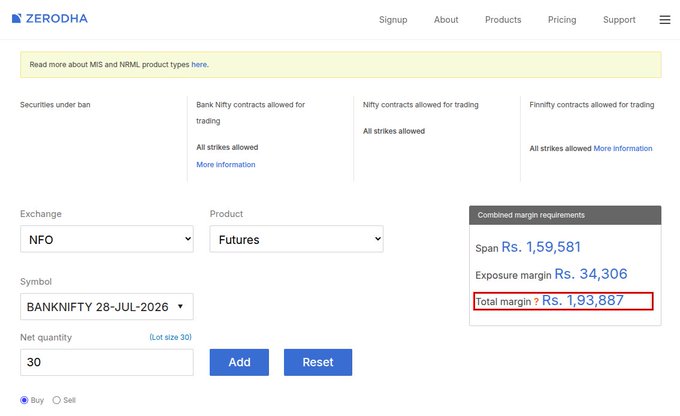
A single lot of Bank Nifty consists of 30 units. At current index levels, this represents a gross market exposure of roughly ₹17 lakh per lot.
Understanding Volatility and Price Behavior
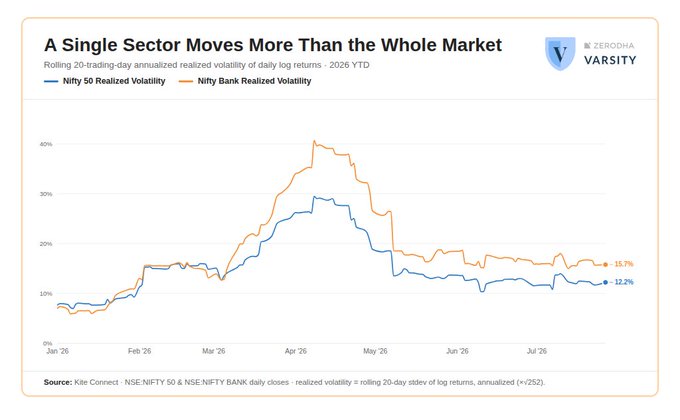
Bank Nifty generally experiences larger price swings than the broader market index, Nifty 50.
Historically, Bank Nifty demonstrates a realized volatility of around 16% per year, compared to roughly 12% per year for Nifty 50.
The move from weekly to monthly expiries has also shifted how positions are managed. While weekly options favored short-term, single-day directional trades, monthly options require positions to span over longer timeframes.
Common Ways Traders Approach Bank Nifty
Because of its deep liquidity, market participants use a variety of instruments and strategies to trade or invest in Bank Nifty.
1. Long Passive Exposure
For non-leveraged exposure, passive funds like Bank BeES track the index directly on the stock exchange. They trade like regular equities without expiry dates or leverage, making them popular for long-term portfolio exposure to the banking sector.
2. Calendar Spreads in Options
Options traders utilizing monthly contracts often implement strategies like calendar spreads. In a typical calendar spread:
- A trader sells the near-month option contract, which experiences faster time decay (theta).
- Simultaneously, the trader buys a far-month option contract at the same strike price, which decays at a slower rate and retains more sensitivity to changes in implied volatility.
3. Hedging and Arbitrage
Institutional investors frequently use Bank Nifty for hedging and cash-and-futures arbitrage. Containing only 14 constituent stocks, the index is relatively easy to replicate compared to broader market indices. This allows institutional desks to trade the index against its underlying basket of stocks when price misalignments occur.
The Influence of Foreign Institutional Investors (FIIs)
Financial services consistently attract the largest share of Foreign Institutional Investor (FII) capital flows in India.
When foreign institutional capital flows into Indian markets, a significant portion is allocated to major banking stocks. Conversely, when foreign investors reduce their holdings, the banking sector typically sees the largest capital outflows.
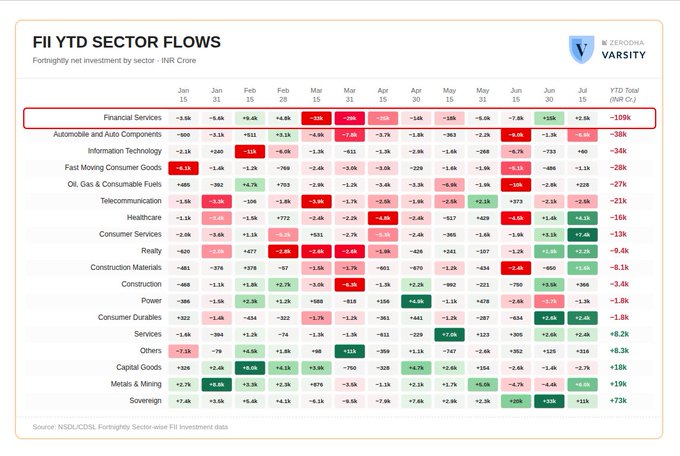
As a result, Bank Nifty acts as more than just a sector-specific index—it serves as a primary barometer for global liquidity moving into and out of Indian equities.
Bank Nifty’s rise to becoming one of India’s most actively traded derivatives is driven by a combination of factors: a concentrated weighting structure, deep institutional liquidity, evolving regulatory frameworks, and adaptable trading strategies. Grasping these foundational characteristics offers a clearer view of how this benchmark index operates within the broader market.