


July 24, 2026
How New Bank Guarantee Rules Impact Proprietary Trading
Akshay Navin | Stock markets
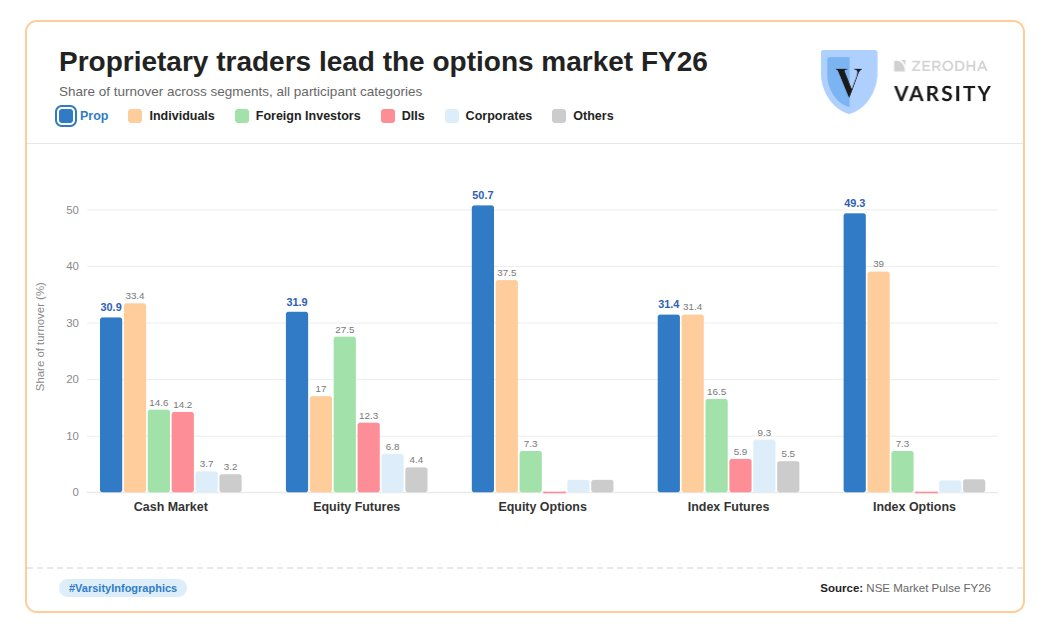
Proprietary traders are the single largest player in India’s options market. To give you some context, they accounted for 50.7% of equity options turnover and 49.3% of index options turnover in FY26.
Starting July 1, the way these large participants fund their trades has changed. This regulatory shift could reshape not just how they trade, but the functioning of the markets themselves.
What is Proprietary Trading?
Proprietary trading is when a broker or trading firm uses its own money to trade in the markets, instead of executing trades on behalf of retail or institutional clients.
Because these firms constantly buy and sell in the market, they provide a massive chunk of the liquidity against which all other participants trade. Without them, order matching would look very different.
The Role of Leverage and Bank Guarantees
Proprietary traders often take on positions that are far larger than their actual cash reserves would allow. They achieve this by using leverage, and one of the most common sources of this leverage is a bank guarantee.
A bank guarantee is essentially a bank vouching for the trader at the stock exchange. It allows the trading firm to meet its necessary margin requirements without needing to deploy physical cash for every trade.
To understand how this worked previously, imagine a ₹100 bank guarantee. Under the older system, a proprietary trading firm could obtain that ₹100 guarantee while locking up far less than ₹100 in eligible collateral with the bank.
This meant a relatively small amount of capital could support a much larger bank guarantee. In simple terms, it allowed firms to enjoy significant leverage.
The New Funding and Collateral Rules
This mechanism has now changed. For proprietary trading, a ₹100 bank guarantee must now be backed 100% by eligible collateral. This collateral must consist of cash, cash equivalents, or government securities. Furthermore, at least ₹50 of that backing has to be actual cash.
As a result, a much larger portion of the firm’s own capital is now tied up just to support the exact same bank guarantee they had before.
Alongside this, there is a second, arguably bigger structural change. Banks are now prohibited from financing proprietary trading in the capital markets. They can no longer lend money to capital market intermediaries to buy securities on their own account.
Therefore, it is not just that bank guarantees require more backing; direct bank lending for proprietary trading has also been cut off.
Gradual Phase-in and Grandfathering
It is important to note that this change will not happen overnight. Bank guarantees that were already issued under the old terms are allowed to continue until they expire, which is typically around a year out.
The new, stricter rules will apply only to fresh bank guarantees and renewals. This process is known as grandfathering, where existing contracts are protected from the immediate impact of a new regulation.
Because of this grandfathering clause, the tighter norms are expected to phase in gradually. As existing bank guarantees expire over the coming months and face renewal under the new framework, the total amount of leverage firms can obtain through bank guarantees will decline over time. Traders are unlikely to feel the full shock of this transition immediately.
What This Means for Market Liquidity
Since proprietary traders provide a massive share of market liquidity, these changes are worth watching. As their access to leverage shrinks and their funding costs rise, some of their trading activity may naturally ease.
For everyday retail traders, this reduction in proprietary volume can eventually show up in the markets as wider bid-ask spreads and less overall market depth.